The Jesus Way · Movement 2 · From Competition to Compassion
The Debt You’ve Forgotten
There’s a moment, possibly many years ago now, when someone let you off the hook.
Maybe you were a teenager and you did something that should’ve had serious consequences, and a parent looked at you and said, “We’re going to move on from this.” Maybe you betrayed someone’s trust, and instead of cold silence, you received a phone call that began with, “I want you to know we’re okay.” Maybe you made a costly mistake at work, and your boss absorbed the fallout without passing it on to you.
You remember the relief. That flood of gratitude and disbelief. The feeling of a weightlifting that you’d already started learning to carry. You remember thinking: I didn’t earn this. I don’t deserve this. And it’s being given to me anyway.
That’s mercy.
And here’s the strange thing about mercy: we tend to remember receiving it in vivid, specific detail. But we’re remarkably fuzzy about the times we’ve withheld it. The times we held a grudge. The times we made someone pay for their failure. The times we were technically in the right and used that position to keep someone in the wrong, long after they’d stopped defending themselves.
We remember being forgiven. We forget that we’re supposed to pass it on.
Jesus, sitting on a hillside at the beginning of his most famous sermon, speaks a single sentence that connects these two things permanently: “Blessed are the merciful, for they’ll receive mercy.”
One Sentence on a Hillside
The Beatitudes open the Sermon on the Mount, and they’re among the most recognizable words Jesus ever spoke. Blessed are the poor in spirit. Blessed are those who mourn. Blessed are the meek. Each one announces a startling reversal: the people the world overlooks are the ones God honours.
The fifth beatitude, “Blessed are the merciful, for they’ll receive mercy,” fits within this larger pattern, but it also introduces something new. The other beatitudes describe conditions: poverty of spirit, grief, meekness, hunger for righteousness. This one describes an action. It’s about something you do. Mercy is a practice, a choice, a way of meeting another person’s failure or need with tenderness when you have every right to respond with harshness.
The Greek word is eleemones, from eleos, which carries the sense of pity, compassion, and active kindness toward someone in distress. In the Septuagint, the Greek translation of the Old Testament, eleos is used to translate the Hebrew word chesed, one of the richest words in all of scripture. Chesed is the loyal, covenant love of God, the love that pursues, forgives, restores, and refuses to let go. When Jesus says, “blessed are the merciful,” the entire weight of Israel’s experience of God’s faithfulness stands behind the word.
This matters because it means mercy, as Jesus uses it, has depth. It’s rooted in the character of God. It’s the human expression of the divine posture toward a broken world. When you show mercy to someone, you’re doing what God has been doing since the beginning of the story.
Mercy in the Sermon on the Mount
The fifth beatitude doesn’t stand alone. It lives inside a sermon that’s saturated with mercy from start to finish.
A few verses later, Jesus teaches his disciples to pray: “Forgive us our debts, as we also have forgiven our debtors.” And then, in case anyone missed it, he adds a commentary: “For if you forgive others their trespasses, your heavenly Father will also forgive you; but if you don’t forgive others, neither will your Father forgive your trespasses.” The language is direct. The logic is reciprocal. Mercy flows in a circuit. It comes to you and it goes through you, and if you block the outflow, the inflow stops.
Later in the sermon, Jesus says: “Don’t judge, so that you won’t be judged. For with the judgement you make you’ll be judged, and the measure you give will be the measure you get.” Same principle. The posture you take toward others is the posture that will be taken toward you. Mercy begets mercy. Harshness begets harshness. You’re setting the terms of your own future every time you respond to someone else’s failure.
And in the sermon’s most radical passage, Jesus says: “Love your enemies and pray for those who persecute you, so that you may be children of your Father in heaven; for he makes his sun rise on the evil and on the good, and sends rain on the righteous and on the unrighteous.” God’s mercy is indiscriminate. It falls on everyone. And the invitation is to become like that, to let mercy flow from us with the same reckless generosity with which it flows from God.
When you read the Sermon on the Mount as a whole, the fifth beatitude emerges as a hinge. Everything before it describes the inner life of the kingdom citizen. Everything after it describes the outward expression of that inner life. Mercy is where the interior transformation meets the world.
The Fruit of What We’ve Been Learning
This is the final post in Movement 2, the journey from competition to compassion, and I want to show how mercy completes the arc.
We began with the disciples arguing about who was the greatest. That’s where the movement starts: in the instinct to compare, to rank, to position ourselves above others. Competition treats people as rivals. Mercy treats them as kin.
We moved to the Good Samaritan, where compassion crossed every boundary the culture had built. Compassion sees the wound. Mercy responds to it. Compassion feels the other person’s pain. Mercy acts on that feeling, often at personal cost.
Last week, we surveyed the moments when Jesus was moved with gut-level compassion: for the hungry, the sick, the grieving, the lost. His compassion was indiscriminate and visceral. And now, with the Beatitudes, we see the fruit that compassion is meant to produce. Compassion is the root. Mercy is what grows from it.
A person who’s been formed by compassion, whose heart has been opened by proximity to suffering, whose instinct is to move toward pain, that person will be merciful. They won’t withhold kindness from the person who’s failed. They won’t hoard forgiveness as leverage. They won’t keep a ledger of wrongs. Mercy will flow from them as naturally as water flows downhill, because they’ve been living in the current of compassion long enough to be carried by it.
You Have to Receive It First
But here’s the thing about mercy that’s easy to miss: you can’t give what you haven’t received.
There’s a sequence to this, and it matters. The beatitude says the merciful will receive mercy, but the deeper truth running through the New Testament is that mercy received is the source of mercy given. You extend mercy to others out of the overflow of mercy that’s been extended to you. If you’ve never tasted it yourself, if you’ve never stood in the place of the one who failed and felt the weight lift, you’ll have nothing to draw on when it’s your turn to lift the weight from someone else.
This is why the Christian life, at its healthiest, begins with an experience of being forgiven. The entire gospel starts here: you are loved. You are held. Your failures have been absorbed by a grace so large it swallows them whole. You don’t have to earn your way back. The door is already open.
People who’ve truly received this become the most merciful people in the room. They’re generous with second chances because they know what it feels like to be given one. They’re slow to condemn because they remember being spared from condemnation. They carry a lightness, a freedom, that comes from knowing their own debt has been cancelled and they have no business collecting from others.
And people who’ve never let mercy reach them tend to be the harshest. They hold others to standards they secretly fear they can’t meet themselves. Their rigidity is a defence against the vulnerability that mercy requires: the admission that you, too, need to be let off the hook.
The order matters. Receive first. Then give. Soak in grace before you try to distribute it. Let yourself be loved in your worst moments before you try to love others in theirs.
The Places Where Mercy Stops
If mercy is so central to the Jesus Way, why do we find it so difficult?
I think it’s because mercy is expensive. Every act of mercy costs the one who gives it. When you forgive someone, you absorb the debt yourself. When you let someone off the hook, you’re the one who stays on it. When you choose not to punish, the injustice sits in your own lap. Mercy always involves a transfer of weight from the one who failed to the one who forgives.
And most of us, if we’re honest, have places in our lives where we’ve decided that transfer is too expensive.
We withhold mercy from the person who hurt us and never apologised. We carry the wound like a stone in our pocket, and every time we touch it, the anger refreshes itself. We tell ourselves we’re “setting a boundary,” and sometimes we are. But sometimes the boundary is a wall, and behind the wall is a person we’ve decided doesn’t deserve our kindness.
We withhold mercy from ourselves. This is the hidden one, the version of mercilessness that’s hardest to name because it wears the mask of high standards. We replay our failures on a loop. We punish ourselves with shame. We speak to ourselves with a cruelty we’d never direct at a friend. And when someone tries to offer us grace, we deflect it. We’ve decided we don’t qualify.
We withhold mercy from people whose politics we oppose. In a culture as polarised as ours, political disagreement has become a sufficient reason for dehumanising the other side. We’ve decided that certain people, because of how they vote or what they believe about issues, are beyond the reach of our compassion. We’ve drawn a line and declared everyone on the other side of it unworthy of mercy.
We withhold mercy from the stranger, the addict, the prisoner, the poor. We construct narratives about personal responsibility that allow us to feel righteous about our indifference. The narrative protects us. It keeps mercy safely in the abstract, where it costs us nothing.
And we withhold mercy from people in our own households. The spouse who keeps failing in the same way. The child who keeps making the same mistakes. The parent who keeps saying the hurtful thing. These are the places where mercy is most needed and most expensive, because the proximity makes the wounds deep and the forgiveness hard.
The Parable That Haunts This Beatitude
Jesus told a parable that illuminates this beatitude with terrifying clarity. It’s in Matthew 18, and it goes like this.
A king decides to settle accounts with his servants. One servant owes him ten thousand talents, the largest number and the largest unit of currency in the Greek language, a debt beyond imagining. The servant can’t pay. He begs for time. And the king, moved with compassion (there’s that word again, splanchnizomai), forgives the entire debt. Wipes it clean.
The forgiven servant walks out of the palace and immediately finds a fellow servant who owes him a hundred denarii, a small, manageable sum, roughly a few months’ wages. He seizes the man by the throat and demands payment. When the man begs for patience, the forgiven servant throws him in prison.
The king hears about it. He summons the servant and says: “You wicked servant! I forgave you all that debt because you pleaded with me. Shouldn’t you have had mercy on your fellow servant, as I had mercy on you?”
The parable is devastating because of the disproportion. Ten thousand talents versus a hundred denarii. An unpayable debt versus a manageable one. And the man who was forgiven everything can’t forgive the small thing. He received mercy on a cosmic scale and blocked it at the first opportunity.
Jesus is pointing at something deep in the human condition: the capacity to receive grace and immediately hoard it. To be forgiven and then to withhold forgiveness. To experience the relief of mercy and then, within the hour, to tighten the screws on someone else.
The parable says: remember what you’ve been forgiven. Let the memory of your own cancelled debt make you generous with others. The mercy you’ve received is meant to flow through you. When you block it, you betray the gift.
Mercy in a Merciless Age
We live in a moment that is, by many measures, allergic to mercy.
Social media has created a culture of public accountability that frequently tips into public destruction. A person makes a mistake, and the response is swift, collective, and absolute. The impulse often begins with legitimate grievance, but it ends in something that looks less like justice and more like vengeance.
In political discourse, mercy has become a liability. To show understanding toward your opponent is to appear weak. To forgive is to be complicit. The only acceptable posture is total opposition, total certainty.
In workplaces, the metrics of productivity leave little room for the mercy of second chances. One bad quarter, one failed project, one public error, and you’re out. The system is built for efficiency, and mercy is inefficient.
Even in churches, mercy can be in short supply. The congregation that speaks constantly about grace can be the same one that shuns the member who’s fallen and constructs elaborate systems for determining who’s in and who’s out.
Into this moment, the beatitude speaks with quiet, stubborn clarity: blessed are the merciful. Happy are those who absorb the cost. Honoured are those who let the debtor walk free. The ones who show mercy will find themselves standing in the stream of mercy that flows from the heart of God.
What Mercy Looks Like in Practice
Mercy is concrete. It shows up in specific moments, in particular relationships, in the small, daily decisions about how we respond to other people’s failures and needs.
Mercy looks like holding your tongue when you have the perfect comeback. You know the thing you could say, the observation that would win the argument and wound the other person. Mercy chooses silence.
Mercy looks like interpreting someone’s behaviour generously. When a friend cancels, when a colleague snaps at you, when a family member says something careless, mercy assumes the best possible motive. Maybe they’re carrying something you can’t see.
Mercy looks like letting a debt go. Financial, emotional, relational. Someone owes you an apology, an explanation, a repayment. Mercy tears up the invoice. This is one of the costliest things a human being can do, and one of the most freeing.
Mercy looks like welcoming someone back after they’ve failed. The prodigal returns. The friend reappears after months of silence. The employee comes back after the termination with a genuine desire to try again. Mercy makes room. It clears a place at the table.
And mercy looks like self-compassion: the willingness to speak to yourself with the same kindness God speaks to you. To stop replaying the failure. To stop weaponizing your own shame. To receive the grace that’s been offered and let it soften the voice in your head that keeps saying you should’ve known better.
A Practice for the Week: A Confession of Withheld Mercy
This week’s practice is a confession. It’s gentle, but it’s honest. And it’s designed to bring you into contact with the specific places where mercy has stopped flowing in your life.
Find twenty minutes of quiet this week. Light a candle if it helps. Sit somewhere comfortably. Take a few slow breaths. And then move through these three steps.
Step one: Remember mercy received. Think of a specific time when someone showed you mercy you didn’t earn. Let the memory become vivid. Remember what it felt like. The relief. The surprise. The gratitude. Sit in that memory for a few minutes. Let it fill you.
Step two: Name mercy withheld. Now, gently, ask yourself: Where have I withheld mercy? Is there a person I’ve refused to forgive? A grudge I’ve been maintaining? A relationship where I’ve been keeping score? A person I’ve written off? A part of myself I’ve refused to treat with kindness? Let the names and faces surface. Write them down if that helps.
Step three: Offer it back to God. You don’t have to resolve anything today. You don’t have to call anyone or write any letters or force yourself to feel forgiveness you don’t yet feel. Simply bring what you’ve named into the presence of God and say something like: “This is where mercy has stopped flowing in my life. I want it to flow again. Help me.”
That’s enough. Confession is a beginning. It opens the door. The mercy that flows through it will take its own time, following its own path, doing its own slow, faithful work.
The Shape of Movement 2
This is the final post in Movement 2, From Competition to Compassion. Let me trace the arc one last time.
We started with rivalry: the disciples arguing about who was the greatest. We moved to the Good Samaritan: compassion that crosses every boundary. We sat with Jesus looking at a crowd of harassed, helpless people and feeling it in his gut. And now, with the Beatitudes, we’ve arrived at mercy: compassion’s fullest expression, the moment when your open heart produces an open hand.
The movement from competition to compassion is the movement from a closed fist to an open palm. It begins in the interior life, with the hard work of noticing where you’re ranking, comparing, and keeping score. It grows through proximity to suffering and the willingness to let it reach you. And it flowers in mercy: the concrete, costly, daily practice of treating others the way God has treated you.
Next week, we begin Movement 3: From Power to Servanthood. We’ll start with James and John asking for thrones and Jesus redefining greatness. The movements keep building, keep deepening, keep inviting us further into the Way. I hope you’ll keep walking with me.
A Question for Reflection
Here’s the question to carry this week:
Who in your life is waiting for mercy you’ve been withholding, and what would it cost you to offer it?
I’d love to hear what surfaces for you. Where did you recognize yourself in this post? Where did you feel the pull of conviction, or the relief of being named? And if you practised the confession this week, what came up?
Share your reflections in the comments or pass this along to someone who might be ready to hear it. Sometimes the most merciful thing you can do is help someone remember the mercy they’ve already received.
Grace and peace to you on the journey.
Image Credit: Photo by Daniel Morris on Unsplash
New Book
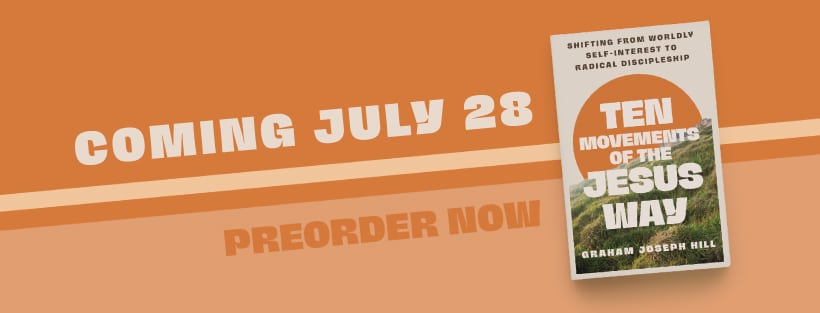
Graham Joseph Hill. Ten Movements of the Jesus Way: Shifting from Worldly Self-Interest to Radical Discipleship. InterVarsity Press, July 2026. Preorder here: https://www.ivpress.com/ten-movements-of-the-jesus-way
About This Series
This post is part of The Jesus Way, a weekly blog series exploring the ten movements that shape a life of following Jesus. Each movement traces a path the Gospels invite us to walk: from the patterns the world rewards toward the life Jesus actually lived and taught.
The series builds toward the release of my book, The Ten Movements of the Jesus Way, coming from InterVarsity Press on 28 July 2026. If you’d like to follow the full journey, you can subscribe to receive each new post as it’s published.
Preorder “The Ten Movements of the Jesus Way” here: https://a.co/d/004aPGwi