Simplicity Parenting: Raising Kids with Less Noise and More Grace
Somewhere in the half-light before dawn, a parent sits at the kitchen table with a cooling cup of coffee and a list that already feels like a verdict. Permission slips. Snack rotations. The pediatrician’s portal. Three texts from the group chat. A reminder that the science fair is closer than it appeared. Outside, the world is hardly stirring, and inside, the day is already in full sprint.
This is the modern parenting life. We’re swimming in noise and running out of breath. The volume rises year by year, and we keep adjusting our hearing while leaving the dial untouched. Somewhere in the static, the children we love most have become projects we manage.
A different way is possible. It’s older than parenting books and louder than our anxieties when we listen for it. It speaks of a different cadence, a different measure of fruitfulness, a different shape for a flourishing life. The ancient streams of Christian wisdom, deepened by centuries of contemplative attention to God, offer parents a vision of formation that begins with quiet, with smallness, with the slow work of grace. They call this kind of life simplicity. They call this kind of love presence. And they insist that what we’re forming in our children is being formed in us first.
The Noise of an Anxious Age
Our age has been called many things. The age of information. The age of distraction. The age of performance. Parents inherit all of it. We carry the weight of cultures that prize productivity, achievements that can be displayed, and identities curated for the watching world. Even our love can become anxious, hovering, prone to measuring. The children sense this. They always do.
Children are growing up under a barrage that their developing nervous systems were never designed to absorb. The phones that pulse in our pockets pulse in theirs. The metrics that judge our worth as adults shape the worth they assign themselves long before they can name what’s happening. Schedules thicken. Sleep thins. The free hours when imagination once unfurled have been colonized by screens and structured enrichment. Anxiety in young people climbs like a fever the culture refuses to take seriously.
We can name what’s happening without succumbing to despair. The diagnosis is the first act of resistance. Something is wrong, and the wrongness lives in the air our children breathe, in the homes we build, in the rhythms we’ve inherited and rarely questioned. The work of simplicity begins with the courage to see this clearly and the deeper courage to believe that another way is real.
A Sabbath Built into the Bones of the World
Scripture begins with a Maker who creates by speaking and rests by ceasing. Six days of generative work, then a seventh held aside as holy. The pattern is woven into the fabric of creation itself. The Sabbath is built into the bones of the world. To live as creatures of this Creator is to know that ceaseless production is a lie, that a life’s worth flows from love and from being held by the One who made us, that rest is a gift placed at the heart of creaturely existence.
Children remember this in their bodies before we teach them to forget. They are born knowing how to be still, how to wonder, how to be wholly absorbed in a beetle on a leaf. We’re the ones who train them out of it. The recovery of simplicity is in part the recovery of what every child once knew and what we, in our own childhoods, knew too.
The kingdom Jesus announced belonged to children. This was a prophetic unveiling. When Jesus placed a child amid the disciples and told them that unless they became like this, they couldn’t enter the kingdom of heaven, he was naming something deep about the shape of life with God. Children receive. Children trust. Children play. Children inhabit time as a gift. The kingdom belongs to those who can still do these things, and our calling as parents is to preserve in our children what the world will be eager to take from them.
The Inner Work That Shapes the Home
The most important work of simplicity parenting happens in the heart of the parent, long before it touches the calendar or the playroom. The home is shaped by what flows out of us, and what flows out of us is what we’ve allowed to live within. A parent steeped in anxiety will pour anxiety into the home regardless of how peaceful the curtains are. A parent who has learned to rest in the love of God will pour that love over everything they touch.
The contemplative tradition has long insisted on this. The exterior life is downstream of the interior life. We become what we behold. The eye that’s fixed on screens, on metrics, on the thousand small fears of a striving culture will be formed by what it watches. The eye that turns toward the One who loves us will be transformed into an eye capable of love.
This is why parents need silence. Not the absence of children, which is rare and not always desirable, but the cultivated silence of a soul that has learned to listen. A few minutes in the morning before the household rises. A walk without earbuds. A practice of putting the phone in another room. The slow re-tuning of attention toward the still, small voice that speaks below the volume of the algorithms.
The parent who prays, even badly, even briefly, even with mostly distractions, is being changed. The prayer creates a small, cleared space in the soul, and that cleared space ripples outward into every interaction with the children. The child being read to senses it. The child being scolded senses it. The child, held in the dark after a nightmare, senses it most of all.
The Gift of Presence
Presence is the gift our children most urgently need and the one we most easily fail to give. The body is in the room, and the mind is in the inbox. The hands are pushing the swing, and the eyes are on the notification. We are, in the language of an older spiritual tradition, scattered. The work of simplicity is in part the work of gathering ourselves into the moment we’re actually in.
This sounds simple, and it isn’t. The contemplatives knew this. They wrote about the wandering mind, the restless heart, the difficulty of being where you are. They developed practices to pull themselves back into the present moment again and again, knowing that God is found in the now and never in the imagined elsewhere. Parents need this same training. The dinner table is a holy place when we are there. The bedtime story is sacred liturgy if we can lay down our phones and enter it.
When we’re present with our children, we communicate something the spoken word can never quite convey. We say: you are worth my full attention. You are my real life. The dishes can wait. The email can wait. You, here, now, in this small moment that will never come again, are what I’m here to attend to. This is theology embodied. This is the love of God translated into the language of a child’s nervous system. The child who experiences such presence learns, deep in the marrow, what it feels like to be beloved. They will spend their lives looking for this, and we have the chance to be among the first to teach them what it tastes like.
Holy Rhythms in a Small Monastery
Every home is a small monastery. The question is which liturgies are forming our children, because liturgies are forming them, whether we have chosen them or simply absorbed them. The morning routines, the meal patterns, the bedtime rituals, the way we mark Sundays, the cadence of our seasons: all of it is shaping the spiritual imagination of the children in our care. The ancient communities of faith understood this. They built their lives around hours of prayer, days of fasting, seasons of feasting, rhythms that taught the body what the mind could only partly comprehend.
Modern families can recover something of this without becoming monastic. A simple grace before meals, said without performance. A practice of putting away screens at a fixed hour. A bedtime that includes a few minutes of reading and a blessing spoken over the child. A weekly Sabbath that, imperfect as it will be, declares to children that there’s a day when we’re free from the demands of production and hurry. Rhythms like these become the architecture of the soul. The child raised within them carries the shape of grace into their adult life.
Simplicity in the home means fewer toys, fewer activities, fewer commitments, more space for the children to be bored and to discover what their imaginations do when given room. The empty afternoon is a kind of garden. Things grow there that can never grow in the over-scheduled hour. The parents who guard such empty afternoons against the cultural pressure to fill them are doing holy work, even when it feels like negligence.
The seasons of the church year offer a gift to families willing to receive it. Advent waiting in the dark with a candle slowly burning. Lent with its quiet renunciations. Easter with its full-bodied feasting. Pentecost with its winds of fresh beginning. These ancient rhythms give children a story bigger than the consumer calendar. They teach the child that time itself has shape, that we live inside a narrative of grace, that the year turns through hope and longing and joy and remembrance. A family that lights candles in Advent and dances at Easter is teaching theology more deeply than any catechism could.
Laying Down the Curated Life
Parents in this age live under an impossible gaze. We’re being watched, and we’re watching ourselves being watched. The curated photo, the highlight reel, the sense that our parenting is a performance for an audience that includes our own internal critics: all of this is exhausting, and it’s deforming. Our children are growing up watching us perform a life while they wait for us to live one. They learn early that life is something to be put on display.
The path of simplicity asks us to lay this down. The love of beauty, which is good, can stay. The joy of celebration, which is holy, can stay. What needs to go is the compulsion to make our lives into content for others’ consumption, the gnawing comparison with families whose carefully framed images bear little resemblance to their actual lives, the slow erosion of our capacity to be present in moments we aren’t capturing on a phone.
There’s a freedom waiting on the other side of this letting go. It feels strange at first, like missing a limb that has become accustomed to constant motion. With time, the freedom becomes its own reward. The dinner that wasn’t photographed was nourishing. The vacation no one saw was healing. The ordinary Tuesday afternoon, undocumented and unwitnessed, becomes its own kind of glory. Children who grow up in homes free from the pressure to perform learn that life has weight and worth in itself, that being is enough, and that they’re loved without having to be impressive.
The Bedrock of Grace
Underneath all the practices, beneath every rhythm and every effort at simplicity, there is grace. Without it, this whole vision becomes another exhausting program of self-improvement, another set of standards by which we measure and find ourselves wanting. Parents are tired enough. The good news of the gospel arrives precisely here: we’re loved before we’ve done anything. Our children are loved before they’ve done anything. The whole project of life is held in a love that arrives before we’ve earned it and remains when we’ve done everything to forget it.
This is the foundation. The simplicity we cultivate, the rhythms we keep, the presence we offer, all of it grows from love rather than producing it. Love comes first. Love makes the practice possible. We rest in love, and from that rest we’re able to give. We trust the love that holds our children in moments when we fail them, and we will fail them. We trust the love that holds us in moments when we cannot trust ourselves.
The parent who knows themselves to be loved without condition can release the death-grip on outcomes. Our children’s stories belong finally to God. Their faith, their flourishing, their futures: all of it is held by the One who loves them more than we do, who knew them before they were knit together, who has plans for them that exceed anything we could engineer. Our calling is faithfulness in the small things. The harvest belongs to God.
This freedom is the gift simplicity offers parents. We can do less because we trust more. We can hurry less because we believe that what’s eternal can’t be rushed. We can stop performing because the One whose gaze matters has already declared us beloved. From this place, parenting becomes something other than a project. It becomes a participation in a love that’s older than the world and more patient than our anxieties.
Practical Wisdom for the Long Road
The practice of simplicity parenting unfolds in countless small choices over many years. A few touchstones may help.
Begin with sleep. A well-rested family is a family with a fighting chance. Protect the bedtime hour with a fierceness that might surprise you. Most evening obligations can be declined. The cost of saying yes to too many things is paid in the currency of children who can’t fall asleep.
Eat together when you can and make the table a place of conversation. The shared meal is one of the most ancient and most powerful liturgies of family life. Phones away. Eyes up. Stories told. Even three nights a week is a foundation that will hold.
Build a Sabbath, even a modest one. One day, one afternoon, one evening, when the family stops, plays, rests, worships, lingers. The shape will be your own. The principle is to declare, with your time, that you live as people held by love and freed from the production line.
Read aloud to children long after they can read for themselves. Reading aloud is a form of presence, and it carries language, story, and imagination into them in ways nothing else does.
Be in nature regularly. The created world teaches what no curriculum can. A child who knows the names of three local birds is a child whose attention has been trained on something real.
Pray with your children, awkwardly if necessary. They will remember a stumbling prayer offered in their bedroom long after they’ve forgotten the eloquent sermons of their childhood pastors. The most important prayers will be the ones spoken in the ordinary places of your home.
Apologize when you fail them. Children flourish when their parents acknowledge mistakes. The repaired rupture is one of the deepest formations a child can receive. They learn that love is stronger than failure, that grace is real, that they live in a world where things broken can be mended.
Toward the Quiet Sanctuary
The vision of simplicity parenting is a leaning into the kingdom that’s always breaking in, the kingdom where children sit at the center of the circle, where time is a gift, where love is the only economy that finally counts. We won’t do this perfectly. None of us will. The gospel is good news for parents precisely because the gospel is for those who fall short, who lose patience, who forget what they meant to do, who find themselves at the end of another long day, wondering if any of it is taking root.
It is. The slow work of grace is happening even when we can’t see it. Every small act of presence, every refusal to rush, every cultivated silence, every prayer whispered over a sleeping child, every meal shared without phones, every Sabbath kept however imperfectly: all of it is being woven into something we can’t yet see. We’re planting seeds in soil that belongs to God. The growth is God’s work.
The world our children are inheriting will be loud. The pull toward distraction, performance, and exhaustion will not relent. We can give them, while they’re with us, a different memory. A memory of a home where they were known. A memory of being looked at with full attention. A memory of unhurried time in the presence of people who loved them. A memory of grace. They will draw from this well for the rest of their lives, especially in the seasons when the world is at its loudest.
May our homes become quiet sanctuaries in a clamoring age. May our presence be the gift we most consistently give. May the rhythms we keep teach our children, in their bones, that they’re loved by a God who is not in a hurry. May the grace that holds us hold them too, and may they grow up knowing, in the deepest places of who they are, that they were beloved long before they could remember and will be beloved long after they have forgotten.
This is the Way. The road is narrow, and the load is light. The One who calls us walks with us. The children in our care are gifts entrusted to us for a season. May we hold them with open hands. May we love them with quiet strength. May we trust the One whose love for them outruns our own.
Photo by Jessica Rockowitz on Unsplash
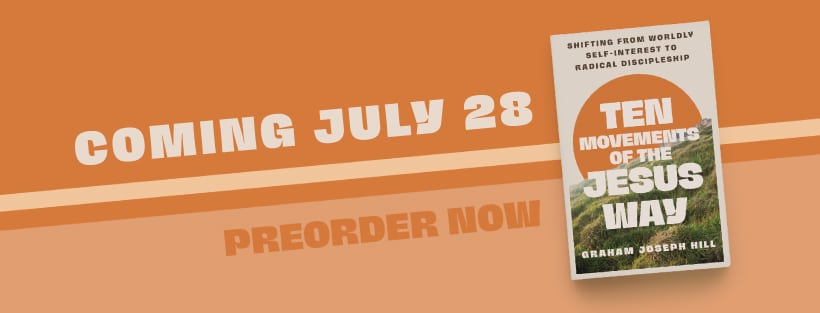
Preorder “The Ten Movements of the Jesus Way” here: https://a.co/d/004aPGwi