The Jesus Way · Movement 3 · From Power to Servanthood
The Reasonable Voice
Most temptation, in my experience, doesn’t come dressed as evil.
It comes dressed as a reasonable solution to a real problem. It comes wearing the language of stewardship, responsibility, and prudence. The voice in your ear isn’t hissing, “Do something wicked.” It’s whispering, “You’re being foolish to wait. You have the means. Why not use them?”
This is what makes temptation so durable across the centuries. The grand, theatrical evils are easy to refuse. The temptations that actually work on us are the subtle, sensible ones. The shortcut that would make our lives easier. The compromise that would secure the outcome we’re anxious about. The exercise of power that would resolve, in five minutes, a situation we’ve been agonizing over for months.
Two thousand years ago, in a wilderness east of Jerusalem, Jesus faced three temptations of exactly this kind. Reasonable ones. Defensible ones. Temptations dressed as stewardship, trust, and effective ministry. And in his refusal of all three, he revealed what the Jesus Way actually costs and what it actually produces.
Driven into the Wild
Matthew’s account begins with a startling phrase: “Then Jesus was led up by the Spirit into the wilderness to be tempted by the devil.”
Notice the agency. The Spirit leads him there. The wilderness is part of God’s plan, woven into the fabric of what the Father is doing in his Son. Mark uses an even stronger word, ekballei, which means “to drive out,” or “to expel.” The same Spirit that descended on Jesus at his baptism, the moment when the Father’s voice declared, “This is my beloved Son, in whom I’m well pleased,” now propels him into forty days of hunger and confrontation.
This sequence matters. The wilderness comes immediately after the affirmation. The voice from heaven is barely finished saying “beloved” when Jesus is in the desert with the tempter. There’s a pattern in scripture and in the spiritual life: deep affirmation is often followed by deep testing. The mountaintop experience gives way to the valley. The moment of clarity is followed by the moment of confusion. The taste of God’s love is followed by the question, “Is this love really enough?”
The number forty echoes through the Old Testament. Forty days of rain in the flood. Forty years in the wilderness for Israel. Forty days on the mountain for Moses. The number signals a season of formation, a stretch of time long enough for the false self to be stripped away and the true self to emerge.
And the wilderness itself matters. Jesus is alone. He’s hungry. He’s exhausted. He’s in a place where the comforts and distractions of daily life have been removed. This is when the tempter approaches. Temptation always finds you at your most depleted. It comes when your defenses are lowest, when your hunger is highest, when the distance between what you want and what you have is most painful. The devil knows the right moment to make his offer.
Stones into Bread: The Temptation of Self-Sufficiency
“If you are the Son of God, command these stones to become loaves of bread.”
Notice the opening: “If you are the Son of God.” The tempter is doing more than offering bread. He’s questioning Jesus’s identity. The Father has just declared at the baptism, “This is my Son.” The tempter immediately asks, “Are you sure? Prove it.” The first weapon in the tempter’s arsenal is the seed of doubt about who you are.
And the offer itself is reasonable. Jesus is hungry. He has the power. The stones are right there. Why suffer when a simple miracle would solve the problem? This is stewardship, surely. This is taking care of yourself. This is using the gifts God has given you for the purpose they were designed for.
But the temptation runs deeper than hunger. The deeper offer is self-sufficiency. The temptation to bypass dependence on the Father and meet your own needs through your own power. To live in a universe where you are the one who fills your own emptiness.
Jesus’s response comes from Deuteronomy 8:3: “One does not live by bread alone, but by every word that comes from the mouth of God.”
The verse comes from Moses’s reflection on Israel’s wilderness years. God let them go hungry, then fed them with manna, to teach them that physical bread alone wouldn’t sustain them. They lived by something deeper: the daily provision of God, received with empty hands. The wilderness was their school of dependence.
Jesus, in his own wilderness, embraces the same school. He refuses to step out of the position of trust. He chooses to remain hungry, leaving the stones unturned. He stays in the place where God provides, even when God’s provision is delayed, and the stones look tempting.
This is the first temptation we face, every day, in a thousand small ways. The temptation to handle it ourselves. To meet our own needs without waiting on God or asking anyone for help. To turn our gifts into instruments of self-provision and forget that we live by every word from God’s mouth.
The Pinnacle of the Temple: The Temptation of Spectacle
The second temptation moves the scene. The devil takes Jesus to the holy city, sets him on the pinnacle of the temple, and says: “If you are the Son of God, throw yourself down; for it’s written, ‘He’ll command his angels concerning you,’ and ‘On their hands they’ll bear you up, so that you won’t dash your foot against a stone.’”
The tempter has learned. This time, he quotes scripture. He pulls a verse from Psalm 91, a beautiful psalm of trust in God’s protection, and he uses it to suggest that Jesus should put on a show.
Picture the scene. The pinnacle of the temple was the highest point of the most sacred building in Israel. Below it, the temple courts would’ve been crowded with worshippers. If Jesus jumped and floated to the ground unharmed, carried by angels, the entire city would witness it. He’d be acclaimed as the Messiah within an hour. His ministry would be launched with a viral miracle. The people would have no doubt about who he was.
This is the temptation of spectacle. The temptation to use dramatic, public, unmistakable signs to establish your authority. To bypass the slow work of teaching, healing, walking with people, dying for them, and instead grab attention through a single unforgettable gesture.
And it’s a temptation that runs deep in religious life. The hunger for spectacle, for proof, for the dramatic moment that would settle every question about whether God is real and whether we’re right to follow. It drives modern Christianity’s fascination with celebrity pastors, viral testimonies, and dramatic claims of God’s direct intervention. We want the show. We want the kind of certainty that doesn’t require trust.
Jesus’s response, again from Deuteronomy: “You shall not put the Lord your God to the test.”
There’s a difference between trusting God and testing God. Trust receives what God gives. Testing demands that God prove himself on our terms. Trust says, “I’ll walk this road with you.” Testing says, “Do this thing for me, in this way, on this timeline, and then I’ll know you’re trustworthy.”
Jesus refuses to manipulate the Father into a public demonstration. He refuses to use his Sonship as leverage for spectacle. He chooses the slow road: the road of teaching crowds in Galilee, healing one person at a time, walking dusty roads with twelve confused men, and eventually dying on a Roman cross. The ministry that begins with this refusal will end with another temple-related moment, when crowds shout, “Come down from the cross, and we’ll believe.” Jesus will refuse that spectacle, too.
The Kingdoms of the World: The Temptation of Power
The third temptation is the most audacious. The devil takes Jesus to a very high mountain, shows him “all the kingdoms of the world and their splendor,” and says: “All these I’ll give you, if you’ll fall down and worship me.”
Notice what’s being offered: power. Real, geopolitical, worldly power. Authority over the kingdoms of the earth. The very thing James and John would later ask Jesus for, the thing the disciples kept dreaming about, the thing the Messianic expectation of Israel was built on. The tempter is offering Jesus the throne that everyone expected him to take.
And the price seems almost reasonable, given the prize. A single act of worship. One bow. A momentary acknowledgment that the tempter has authority worth recognizing. In exchange, the kingdoms of the world. The shortcut. The end without the means. The crown without the cross.
This is the temptation that has corrupted more religious leaders than any other. The temptation to take power on the world’s terms in order to do God’s work. To compromise just enough to get into the seat of influence, where you can do so much good. To bow to whatever idol the culture is currently worshipping, in exchange for access, platform, and reach.
Every generation has faced this. The medieval church accepted political power and lost its prophetic voice. Modern movements have wrestled with the offer of cultural alliance and what such alliances cost in moral integrity. Every leader, in every domain, eventually faces some version of the question: What would you bow to in order to gain the influence you crave?
Jesus’s answer, once more from Deuteronomy: “Worship the Lord your God, and serve only him.”
And then, with breathtaking authority: “Away with you, Satan!”
Jesus refuses the shortcut. He chooses the long road, the costly road that winds through years of itinerant ministry, growing opposition, betrayal, trial, and execution. The kingdom he’ll inaugurate will look nothing like the kingdoms the tempter showed him on the mountain. It’ll be a kingdom of mustard seeds and yeast, of children and outcasts, of bread broken and wine poured, of a king on a donkey and a throne shaped like a cross.
He’ll get the kingdoms in the end, but on the Father’s terms, through the Father’s means, in the Father’s timing. The same power was on offer. Jesus refused to take it the easy way.
The Pattern Beneath the Three
When you place the three temptations side by side, a pattern emerges. Each one is an offer to grab control. Each one is an invitation to step out of the position of trust and into the position of the self-sufficient operator.
The first temptation says: meet your own needs. Don’t wait on God. Use your power to provide for yourself.
The second temptation says: prove your identity. Don’t live by faith. Use a spectacle to establish, beyond doubt, that you matter.
The third temptation says: secure your future. Don’t walk the long, costly road. Take a shortcut to the destination.
All three are versions of the same fundamental temptation: stop trusting the Father. Take the wheel. You can do this faster, better, and on your own terms. You don’t have to wait. You don’t have to be vulnerable. You don’t have to live in the uncomfortable space between the promise and its fulfillment. You can have it now, your way, on your timeline.
And Jesus, in refusing all three, models a different posture. The posture of the trusting Son. The one who lives from his Father’s word. The one who waits for his Father’s vindication. The one who walks the road his Father has set, even when faster roads are on offer.
This is the heart of Movement 3, the journey from power to servanthood. The path of Jesus is the path of relinquished control. He has the power to do all three of these things. The temptations are real. He genuinely could turn stones into bread. He genuinely could survive a fall from the temple. He genuinely could rule the kingdoms of the world. His refusal flows from a deeper form of obedience: the willingness to live within the limits the Father has set, even when limits feel intolerable.
Our Subtle Grasping
Most of us will never face Jesus’s temptations in their dramatic form. We won’t be offered global power. We won’t be standing on the temple pinnacle. But the underlying temptations show up in our lives every day, in disguised, domesticated forms.
The temptation of self-sufficiency shows up in our refusal to ask for help. We tell ourselves we don’t want to be a burden. We pride ourselves on handling things ourselves. We construct lives so independent that we never have to admit need to anyone, including God. The piety of self-sufficiency wears the costume of strength, but underneath is an unspoken refusal to receive.
It also shows up in our anxious doing. The endless productivity. The over-functioning. The inability to rest. We turn stones into bread because we’re afraid of what will happen if we stop. So we keep performing, keep producing, keep filling every gap in our schedule with another task, another commitment, another way to make ourselves useful and indispensable.
The temptation of spectacle shows up in our hunger for recognition. The need to be seen. The careful curation of our public selves. The disappointment when our work goes unnoticed. We want our value to be obvious, certified, and applauded. The slow, hidden work of faithfulness feels too uncertain. We want the dramatic moment that settles every question about whether we matter.
It shows up especially in spiritual life. We want testimonies of dramatic answers to prayer. We want unmistakable signs of God’s presence. The faith that walks slowly through ordinary days, trusting a God who often seems silent, feels too vulnerable. We’d rather have proof.
The temptation of power shows up in our shortcuts. The little compromises that secure the outcome we want. The lie that protects the relationship. The strategic friendship with someone who can advance our standing. The subtle bowing to whatever idol the culture currently worships in our particular field, because the alternative is to be left out, ignored, and marginalized.
It also shows up in our control. The micromanaging of our families. The grip we keep on our calendars. The strategic positioning we do at work. The fantasy that if we just plan thoroughly enough, if we just account for every variable, we can guarantee the future we’re hoping for.
All of it traces back to the same root. We don’t trust that we’re held. We don’t trust that God is good. We don’t trust that the slow road of faithful obedience will get us anywhere worth going. So we grab. We perform. We compromise. We insist on the shortcut.
The Path of Trust
Jesus’s response to all three temptations is the same posture, expressed in different verses: trust the Father. Live by his word. Don’t test his faithfulness. Worship him alone.
Trust is the alternative to grasping. It’s the spiritual posture that allows you to live within the limits of your humanity, to wait on God’s timing, to walk the slow road, and to refuse the shortcuts on offer. And it’s a posture that has to be practiced, because every part of our culture trains us in the opposite direction.
We live in a moment that prizes control above almost any other virtue. Self-help is a multibillion-dollar industry. Productivity culture treats every minute as a resource to be optimized. Even our spiritual lives have absorbed this logic, with their daily disciplines, growth metrics, and life plans.
Trust is countercultural in such a moment. Trust says: I’ll wait. I’ll live within my limits. I’ll accept that I’m not in charge. I’ll let God be God, and I’ll be the one being held.
This sounds passive. It isn’t. Trust is one of the most active, demanding, courageous postures a human being can take. It requires constant, daily refusal of the temptations to grab control. It requires sitting in the discomfort of unresolved situations. It requires saying no to the reasonable shortcuts that would give you what you want, faster, on your own terms.
And it requires a deep, anchored sense of who you are. The tempter began each of his offers with “If you are the Son of God.” The doubt was the tool. Jesus’s ability to resist came from the unshakeable knowledge that yes, he was the Son. The Father had just said so. He didn’t need to prove it through bread, spectacle, or kingdoms. His identity was already secure. The tempter’s offers added nothing.
We refuse our own temptations from the same place. When we know who we are (beloved, held, accompanied), the offers of self-sufficiency, spectacle, and power lose their grip. We don’t need to grab, because we already have what we were trying to grasp for: the love of a Father who has named us his.
A Practice for the Week
This week’s practice is an exercise in noticing. The three temptations show up in our lives constantly, but they’re subtle. They come dressed as productivity, ambition, prudence, and self-care. The first step toward refusing them is recognizing them.
Each day this week, ask yourself three questions, one for each temptation.
Where today did I try to turn stones into bread? Where did I try to meet a need by my own striving, when waiting on God might have been the truer path? Where did I refuse to ask for help, refuse to admit weakness, refuse to be the one who needed someone else?
Where today did I want to throw myself from the temple? Where did I crave spectacle, recognition, the dramatic gesture that would prove my worth? Where did I want to bypass the slow work of faithfulness in favor of a moment that would settle every question?
Where today did I bow for a kingdom? Where did I take a shortcut? Where did I compromise to secure the outcome I wanted? Where did I bow, even briefly, to an idol the culture had set up, in exchange for access, approval, or advancement?
Don’t judge yourself for the answers. Simply notice. Write them down. Let the pattern emerge across the week.
And then, on the seventh day, take twenty minutes of stillness. Read Matthew 4:1–11 slowly. Imagine yourself in the wilderness with Jesus. Picture the three offers being laid before you. And speak Jesus’s answers as your own:
“One does not live by bread alone.”
“You shall not put the Lord your God to the test.”
“Worship the Lord your God, and serve only him.”
Let the words land in your body. Let them become your own response, your own posture, your own way of refusing the offers that come dressed as reasonable solutions.
A Question for Reflection
Here’s the question to carry with you this week:
Where in your life are you grasping for control, and what would it look like to release that grip and trust the Father instead?
I’d love to hear what surfaces for you. Which of the three temptations hit closest to home? Where did you recognize yourself in Jesus’s wilderness? And if you practiced the noticing this week, what patterns emerged?
Share your reflections in the comments, or pass this along to someone who might be standing in their own wilderness right now, listening to a voice that’s offering them a reasonable solution to a real problem.
Next week, we close out Movement 3 with “He Emptied Himself,” a meditation on Philippians 2 and the great hymn of Christ’s self-emptying. We’ll explore what it means to take on the form of a servant and how this pattern is meant to shape every Christian life. I hope you’ll join me.
Grace and peace to you on the journey.
New Book
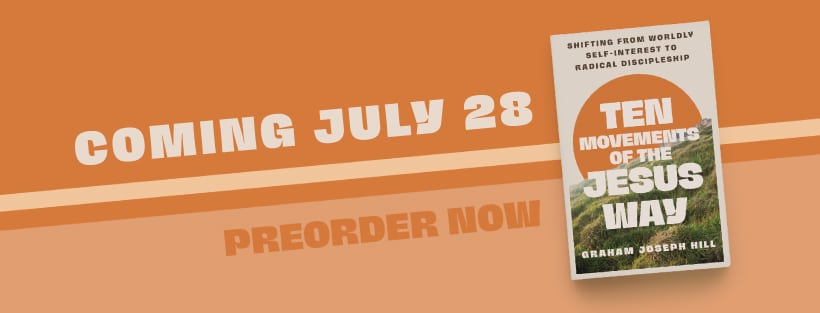
Graham Joseph Hill. Ten Movements of the Jesus Way: Shifting from Worldly Self-Interest to Radical Discipleship. InterVarsity Press, July 2026. Preorder here: https://www.ivpress.com/ten-movements-of-the-jesus-way
About This Series
This post is part of The Jesus Way, a weekly blog series exploring the ten movements that shape a life of following Jesus. Each movement traces a path the Gospels invite us to walk: from the patterns the world rewards toward the life Jesus actually lived and taught.
The series builds toward the release of my book, The Ten Movements of the Jesus Way, coming from InterVarsity Press on 28 July 2026. If you’d like to follow the full journey, you can subscribe to receive each new post as it’s published.
Preorder “The Ten Movements of the Jesus Way” here: https://a.co/d/004aPGwi