The Jesus Way · Movement 1 · From Material Success to Spiritual Riches
The Garage Sale
A few years ago, a friend of mine spent a Saturday morning helping her parents clean out their garage. They had lived in the same house for forty years. The shelves held boxes that had not been opened since the Reagan administration (when Bob Hawke was Prime Minister in Australia). Old trophies. Certificates from employers that no longer existed. China sets still wrapped in newspaper from a move three decades prior. A bread maker, used twice. Exercise equipment draped in cobwebs. Her mother stood in the driveway, looking at all of it piled on folding tables, and said something my friend has never forgotten:
“We spent our whole lives collecting things we thought we’d need someday. And someday never came.”
That sentence has stayed with me. It’s the kind of thing you hear and immediately recognize as true, the kind of truth that makes you glance nervously at your own closets, your own shelves, your own carefully curated life. Because most of us are doing the same thing. We’re storing up. We’re accumulating. We’re building something, brick by brick, whether we realize it or not.
The question is: what?
This is the question Jesus poses in one of his most famous teachings, a handful of sentences from the Sermon on the Mount that are as unsettling today as they were the first time anyone heard them spoken aloud on a Galilean hillside.
The Teaching
Here is the passage, from Matthew’s Gospel, chapter six:
“Don’t store up for yourselves treasures on earth, where moth and rust destroy, and where thieves break in and steal. But store up for yourselves treasures in heaven, where neither moth nor rust destroys, and where thieves don’t break in or steal. For where your treasure is, there your heart will be also.”
Three sentences. That’s all. And yet within them lies a complete diagnosis of the human condition and a prescription for a different kind of life.
Notice what Jesus does here. He begins with an instruction: stop storing up treasures on earth. He follows with a reason: earthly treasures are fragile, temporary, vulnerable to decay and theft. Then he offers an alternative: store up treasures in heaven instead. And finally, he names the deeper truth underneath it all: the location of your treasure reveals the location of your heart.
This last line is the one that lodges in the chest. It’s the line people remember, the one that gets quoted on greeting cards and cross-stitched onto throw pillows. But when you sit with it, really sit with it, it’s a devastatingly honest statement about the way human beings work. Jesus is saying that our treasure and our heart are never in different places. They always travel together. If you want to know where your heart is, look at where your treasure has gone. And if you want to move your heart, move your treasure.
Moths, Rust, and Thieves
To hear this teaching the way its first audience heard it, we need to understand the world Jesus was speaking into.
In first-century Palestine, wealth took tangible forms. Fine garments were a primary store of value. Families passed down expensive robes the way we might pass down financial portfolios. The problem, of course, was moths. A single infestation could destroy a family’s most prized possessions overnight.
Rust, or more accurately the Greek word brōsis, carries the broader meaning of “eating away” or “corrosion.” It could refer to vermin gnawing through grain stores or the slow deterioration of metal. The point is the same: the material world is always in the process of breaking down. Entropy is relentless. Every physical thing you own is, at this very moment, one step closer to dust.
And then there are thieves. In the ancient world, homes were often constructed of mud brick. A thief did not pick a lock. He literally dug through the wall. The Greek word translated “break in” is diorussō, which means “to dig through.” Your treasure was only as secure as a wall of dried mud.
Jesus’s audience would have felt the force of these images immediately. They knew the precariousness of material wealth in their bones. Many of them had experienced it firsthand. They lived in an occupied territory under crushing taxation, where a single bad harvest could mean starvation. The wealthy built larger storehouses and surrounded themselves with guards, but even they understood that their possessions were never truly safe.
And here’s the remarkable thing: in our world of climate-controlled storage units, insurance policies, home security systems, and diversified investment portfolios, we’ve managed to create a convincing illusion that our treasure is safe. We’ve pushed the moths and rust and thieves to the margins of our awareness. But Jesus’s point remains as relevant as ever. Every material thing is passing away. The question is whether we’ve noticed.
What We Store Up and Why
When Jesus says “treasure,” he’s using a word that covers far more ground than money in a bank account. Treasure, in the broadest sense, is whatever we’re investing our lives in. It’s what we store up, protect, accumulate, and organize our days around.
For some of us, treasure looks like financial wealth. We check our portfolio balances the way previous generations checked the weather: first thing in the morning, as a way of assessing whether the day will be good or bad. Our mood rises and falls with the market. We feel a quiet pride when numbers go up and a gnawing anxiety when they go down. And underneath all of it’s a belief, rarely spoken but deeply held, that enough money will eventually make us safe.
For others, treasure takes the form of reputation. We store up approval. We accumulate the good opinions of others and guard them fiercely. We curate our social media presence with the same care a museum curator gives to a priceless collection. Every post is an investment. Every interaction is an opportunity to add to the storehouse. And when someone criticizes us, when our reputation takes a hit, it feels like a thief has dug through the wall.
Still others store up accomplishments. Degrees, titles, publications, promotions, awards. Each one goes into the vault. Each one is supposed to answer the question that haunts us in the quiet hours: Am I enough? Have I done enough? Will I be remembered?
And some of us store up comfort and control. We arrange our lives to minimize risk and maximize predictability. We build routines like fortresses. We avoid vulnerability. We keep people at a safe distance. Our treasure is the illusion that we’re in charge of our own story.
Jesus sees all of this. And he’s tender about it. There’s no anger in his voice here, no condemnation. He’s doing what a good doctor does: describing the illness clearly so that healing can begin. He knows why we store up earthly treasure. We do it because we’re afraid. We do it because the world is unpredictable and our hearts crave security. We do it because we’ve been told, by every advertisement and cultural message since childhood, that accumulation is the path to the good life.
And Jesus, with the quiet authority of someone who sees straight through to the bottom of things, says: that path leads to moth-eaten garments and corroded metal and broken walls. There’s another way.
Treasures in Heaven
So, what are these “treasures in heaven” that Jesus commends?
Here is where we need to be careful. The phrase “treasures in heaven” has often been interpreted as a kind of spiritual retirement plan: be good now, and you will be rewarded later. Sacrifice in this life, and God will pay you back in the next. This reading turns the gospel into a transaction, a celestial investment scheme with delayed returns.
But Jesus is pointing at something far more alive than that. When he speaks of heaven, he’s speaking of the reality of God’s presence, God’s kingdom, God’s way of ordering the world. And that reality, he insists throughout his ministry, is already breaking into the present. “The kingdom of God is at hand,” he says. It’s here. It’s near. It’s available now.
To store up treasures in heaven, then, is to invest your life in things that participate in God’s reality. It’s to give your time, your money, your energy, your attention to the things God cares about: mercy, justice, compassion, reconciliation, love. These are the things that moths can’t eat and rust can’t corrode. They’re the things thieves can’t steal. They’re imperishable because they participate in the life of God, which has no end.
Think of it this way. When you forgive someone who has wronged you, something real happens in the fabric of the universe. When you feed someone who is hungry, something eternal takes shape. When you sit with someone in their grief, when you tell the truth at personal cost, when you give generously without expectation of return, you are depositing treasure in the only vault that will never be broken into.
This is what the saints have always understood. The great mystics and monastics and ordinary believers who have organized their lives around love have always had a quality of lightness about them, a freedom that comes from having let go of the things the rest of us clutch so tightly. They aren’t grim or joyless. They are, if anything, more joyful, more alive, more present than the rest of us, because they aren’t weighed down by the constant anxiety of protecting a hoard of perishable goods.
Dorothy Day, who gave her life to serving the poor in the Catholic Worker movement, once said, “I really only love God as much as I love the person I love the least.” That’s a treasure-in-heaven kind of statement. It relocates value. It redefines wealth. And it exposes the poverty of a life built around accumulation.
The Heart Follows the Treasure
The final line of Jesus’s teaching is the key to the whole thing: “For where your treasure is, there your heart will be also.”
Notice the order. Jesus doesn’t say, “Where your heart is, there your treasure will follow.” He says it the other way around. The treasure goes first. The heart follows.
This is a profound insight into human psychology, and it has been confirmed by centuries of spiritual practice and, more recently, by behavioral science. We tend to think that our actions flow from our beliefs and desires: I care about something, therefore I invest in it. And that’s partly true. But Jesus understood something deeper. Our investments shape our desires. Where we put our money, our time, and our attention, those are the things we come to love.
This is why someone who begins tithing to their church, even reluctantly, often finds that their heart begins to soften toward the community. It’s why someone who starts volunteering at a homeless shelter, even out of obligation, begins to see the people they serve with new eyes. It’s why someone who commits to a daily practice of prayer, even when it feels dry and pointless, gradually discovers a deepening sense of God’s presence.
The heart follows the treasure. Move the treasure, and the heart will follow.
This is incredibly good news. It means that you don’t have to wait until you feel generous to start giving. You don’t have to wait until you feel compassionate to start serving. You don’t have to wait until you feel spiritual to start praying. You can begin with the action, and trust that your heart will catch up. Jesus is inviting us into a practice, a way of life, a set of habits that will gradually transform us from the inside out.
But the reverse is also true, and this is the sobering part. If your treasure is in your career, your heart will be there too. Every setback at work will feel like an existential crisis. Every success will feel like salvation. If your treasure is in your children’s performance, your heart will be hostage to their grades, their behavior, their choices. You will love them, yes, but your love will be tangled up with anxiety and control. If your treasure is in your appearance, your heart will sink every time you look in the mirror and see the evidence of aging.
Where your treasure is, there your heart will be also. It’s a statement of fact. And it’s an invitation to choose.
The Personal Audit
I want to be honest with you. I find this teaching beautiful and terrifying in equal measure.
Beautiful, because it offers such clarity. In a world of competing voices and endless options and constant noise, Jesus cuts through all of it with a single question: Where’s your treasure? That’s it. Answer that question honestly, and you will know the state of your soul.
Terrifying, because when I sit down and look at where my treasure is, the results aren’t always flattering.
I think about the hours I spend scrolling on my phone, consuming content that will evaporate from my memory before the day is over. I think about the mental energy I devote to worrying about things I can’t control. I think about the money I spend on small comforts and conveniences that add up to a staggering sum over the course of a year, money that could have fed the hungry, sheltered the homeless, or funded the work of healing in my community.
I’m not saying this to perform guilt. Guilt is rarely productive, and Jesus isn’t interested in making us feel bad. He’s interested in making us free. And freedom begins with seeing clearly.
There’s a practice in many monastic traditions called the examen, a daily review of the hours just passed. You look back over your day and notice where you felt most alive and most drained, where you moved toward God and where you moved away. It’s a gentle, honest reckoning. And I think something similar is what Jesus is inviting us into here.
He’s inviting us to conduct a quiet audit of our lives. To look at our bank statements and our calendars and our screen time reports, and to ask a simple question: What do these things reveal about what I treasure?
This is sacred work. It’s uncomfortable, yes. But it’s the kind of discomfort that leads to growth, the growing pains of a soul stretching toward something larger.
What Are You Building Your Life Around?
There’s a question underneath Jesus’s teaching that I think he wants us to sit with for a long time: What are you building your life around?
Every life is built around something. Every life has a center of gravity, a core commitment, an organizing principle. For some of us, that center is clear and intentional. For many of us, it’s something we’ve never articulated, something that has taken shape gradually, through a thousand small decisions, like a river carving a canyon through rock.
Jesus is asking us to notice. To name the thing. To hold it up to the light and examine it honestly.
Is your life built around security? Around approval? Around achievement? Around comfort? Around control?
Or is it built around love? Around generosity? Around faithfulness? Around the slow, patient work of becoming the kind of person who looks like Jesus?
This is the invitation of the Jesus Way. It’s the first movement in a lifelong journey: the movement from material success to spiritual riches. And it doesn’t begin with dramatic gestures or heroic sacrifices. It begins with noticing. It begins with paying attention to where our treasure is, and then, gently, courageously, beginning to move it.
A Practice for the Week
I want to close with something concrete. If this teaching has stirred something in you, here’s an invitation for the coming week.
For seven days, practice noticing where your money, your time, and your attention flow.
You don’t need to change anything yet. You don’t need to fix anything or feel guilty about anything. You simply need to pay attention.
Money: At the end of each day, look at what you spent money on. Write it down if that helps. What do your expenditures reveal about what you value? Where did your money go, and did it go toward things that will last?
Time: At the end of each day, review how you spent your hours. What received the largest portion of your waking life? What received the scraps? What does the allocation of your time tell you about what you treasure?
Attention: This is the subtlest and perhaps the most revealing category. Throughout the day, notice where your mind goes when it isn’t occupied with a task. What do you worry about? What do you daydream about? What captures your imagination? Your attention is the most intimate form of treasure, because it’s the currency of the heart.
At the end of the week, take an hour of quiet. Review what you have noticed. And then bring it to God in prayer. You might say something as simple as: “Lord, this is where my treasure has been. I want to learn to store up treasure with you. Show me how.”
That’s enough. That’s a beginning. And in the economy of God, beginnings are everything.
A Question for Reflection
As you go about your week, carry this question with you:
If someone looked at how I spend my money, my time, and my attention, what would they conclude I treasure most?
I would love to hear your reflections. What did you notice as you read this? What is stirring in you? Feel free to leave a comment below or share this post with someone who might be asking the same questions.
This is the first post in a new series called The Jesus Way, exploring the ten movements that shape the life Jesus invites us into. Next week, we’ll look at the story of the Rich Young Ruler and the things we can’t imagine letting go of. I hope you will walk with me.
Grace and peace to you on the journey.
About This Series
This post is part of The Jesus Way, a weekly blog series exploring the ten movements that shape a life of following Jesus. Each movement traces a path the Gospels invite us to walk: from the patterns the world rewards toward the life Jesus actually lived and taught.
Movement 1, From Material Success to Spiritual Riches, asks what happens when we loosen our grip on wealth, status, and accumulation and discover the abundance God has been offering all along.
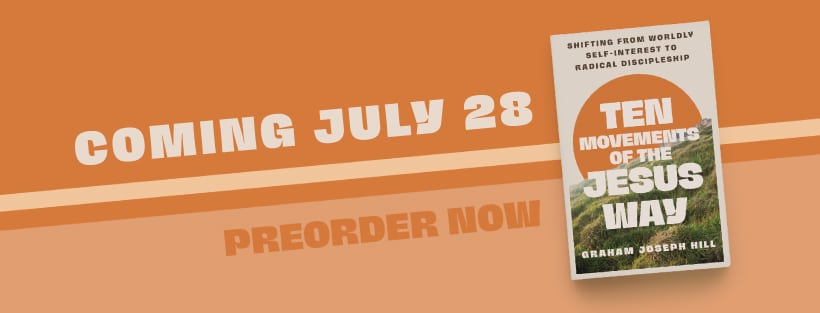
The series builds toward the release of my book, The Ten Movements of the Jesus Way, coming from InterVarsity Press on 28 July 2026. If you’d like to follow the full journey, you can subscribe to receive each new post as it’s published.
Preorder “The Ten Movements of the Jesus Way” here: https://a.co/d/004aPGwi
New Book
Graham Joseph Hill. Ten Movements of the Jesus Way: Shifting from Worldly Self-Interest to Radical Discipleship. InterVarsity Press, July 2026. Preorder here: https://www.ivpress.com/ten-movements-of-the-jesus-way