The Jesus Way · Movement 3 · From Power to Servanthood
The Room That Stopped Breathing
There are moments in life when the temperature of a room changes.
You’ve been in them. The conversation has been flowing easily, jokes and small talk, the comfortable noise of people who know each other. And then someone does something unexpected. They say a thing nobody saw coming. They make a gesture that doesn’t fit the script. And the air shifts. Conversations halt mid-sentence. People glance at each other. The atmosphere goes still and watchful, and everyone in the room knows, without anyone saying it, that something significant is happening.
John’s Gospel describes a scene like that. It’s Thursday evening of the most consequential week in human history. Jesus and his disciples are reclining around a table for the Passover meal. The conversation has presumably been flowing. There’s wine, bread, the familiar liturgy of a feast they’ve celebrated together many times. And then, in the middle of the meal, Jesus stands up.
He removes his outer robe. He picks up a towel and ties it around his waist. He pours water into a basin. And he kneels down at the feet of the man closest to him.
The room stops breathing.
What happens in the next ten minutes is one of the most quietly explosive scenes in all of scripture. It’s a teaching delivered without words. A sermon preached with a basin and a towel. And it overturns, in real time, everything the disciples have ever believed about power, status, and what it means to be great.
Before the Towel
John gives us an unusually theological introduction to this scene. He sets the table for us, literally and figuratively, in a single sentence: “Jesus, knowing that the Father had given all things into his hands, and that he’d come from God and was going to God, got up from the table, took off his outer robe, and tied a towel around himself.”
This is one of the most loaded sentences in the New Testament. John wants us to understand exactly who is doing the foot-washing. Jesus knows. He knows the Father has placed everything in his hands. He knows where he came from and where he’s going. He knows his own identity and authority with absolute clarity.
And from that place of total security, he takes off his robe and picks up a towel.
This sequence matters because it tells us something important about humility. The foot-washing is the act of someone who is anchored. Jesus isn’t serving from a place of self-doubt or self-erasure. He’s serving from a place of unshakeable identity. He knows who he is. He knows whose he is. And precisely because he knows, he can stoop without losing himself.
This is a key insight for anyone trying to walk the Jesus Way. The deepest service flows from the deepest security. People who are unsure of their own value tend to use service as a way to earn it. They give in order to be seen. They serve in order to be praised. Their humility has hooks in it. But people who know they’re loved, who’ve received their identity as a gift, can serve freely. They have nothing to prove. The towel leaves their dignity untouched, because it was never on the line in the first place.
The Scandal of the Basin
We’ve heard this story so many times that we’ve lost the shock of it. Foot-washing has become a Maundy Thursday liturgy in some churches, a sentimental tableau, a sermon illustration. To recover what it actually meant, we need to feel the scandal.
In the first-century Mediterranean world, washing feet was the lowest household task. Streets were dirty. Sandals were minimal. By the end of a day’s walking, feet were caked with dust, sweat, and worse. When guests arrived at a home, the host typically arranged for their feet to be washed before they reclined for a meal. The task was assigned to the lowest-ranking servant in the household, almost always a slave, and usually a Gentile slave at that.
Some Jewish texts went so far as to declare that foot-washing was so demeaning that a Jewish slave couldn’t be required to perform it. It was beneath them. Only the lowest of the low were given the basin.
This is the task Jesus chooses.
And he chooses it not at the start of the meal, when foot-washing would’ve been customary, but in the middle. The disciples have already been reclining. Their feet, presumably, were washed by someone else when they arrived, or perhaps not at all. Jesus interrupts the meal to do this. The timing makes the gesture even more startling. He’s not fulfilling a hospitality requirement. He’s performing a deliberate, theatrical act of teaching.
Picture it from the disciples’ perspective. The teacher they’ve come to believe is the Messiah, the chosen one of God, the king who’ll restore Israel, gets up from his seat at the head of the table. He removes his outer garment, leaving him in the simple inner tunic of a slave. He ties a towel around his waist. He kneels. And one by one, he takes their feet, those calloused, dusty, sweaty feet, in his hands.
There’s no parallel for this in the ancient world. Rabbis didn’t wash their disciples’ feet. Masters didn’t wash their slaves’ feet. The vector of service ran one way, always upward. What Jesus is doing is a category violation. It’s a public, embodied refusal of the entire hierarchy of honour and shame that structured his society.
Peter’s Refusal
Eventually Jesus arrives at Peter, and Peter does what Peter always does: he speaks first and thinks later.
“Lord, are you going to wash my feet?”
You can hear the disbelief in his voice. The horror. Peter has watched Jesus with the leper, the bleeding woman, the children, the tax collectors. He’s seen Jesus cross every social boundary his culture knew how to draw. But this is different. This is too far. The Messiah does not kneel at the feet of a fisherman.
Jesus answers gently: “You don’t know now what I’m doing, but later you’ll understand.”
Peter doubles down: “You will never wash my feet.”
And here’s where the scene becomes one of the most psychologically revealing moments in the Gospels. Because Peter’s refusal sounds like humility. On the surface, he’s saying: I’m not worthy of this. You’re too important for this. Stay where you belong, Lord, and let me stay where I belong.
But underneath the language of humility is something else entirely. Peter is refusing to receive.
He wants Jesus to remain the kind of Messiah Peter can understand: powerful, distant, occupying his proper position at the top of the hierarchy. A Messiah on his knees disorders Peter’s entire framework. If Jesus serves like this, then everything Peter has assumed about greatness, status, and what it means to follow Jesus is wrong. And Peter, like most of us, would prefer almost anything to having his framework upended.
Jesus’s response cuts through the protest: “Unless I wash you, you have no share with me.”
This is one of the most important sentences in the passage. Jesus is saying: there’s no other way in. You can’t walk the Jesus Way while refusing to be served by Jesus. You can’t follow a master who kneels unless you let him kneel for you. The whole thing depends on your willingness to receive what you didn’t earn and don’t feel worthy of.
Why We’d Rather Serve Than Be Served
I want to linger on Peter’s resistance, because I think it’s where most of us live.
Most of us, if we’re honest, find it easier to serve than to be served. We’re comfortable in the giving role. We’ll bring the meal to the family in crisis. We’ll volunteer at the shelter. We’ll write the cheque. What we struggle with is the receiving role. When the family in crisis is ours, when we’re the one who needs the meal, the visit, the help with the kids, something inside us tightens. We deflect. We minimise. We say, “Oh, you don’t need to do that, we’re fine.”
Why?
Part of it is pride. Receiving puts us in the lower position. It admits that we have a need we can’t meet ourselves. In a culture that worships self-sufficiency, that admission feels like failure.
Part of it is the exchange instinct. If someone serves us, we feel we owe them. The unbalanced ledger creates discomfort. We’d rather be the one with the credit balance than the debt balance.
Part of it is control. When you’re the server, you’re managing the encounter. You decide what to give, when, and how. When you’re being served, you’re in a more vulnerable position. You’re receiving someone else’s gift on their terms.
And part of it, the deepest part, is the suspicion that we don’t deserve it. There’s a quiet voice inside many of us that says: I’m not worth this kind of attention. The good things in life should go to other people.
Peter’s “you will never wash my feet” is the voice of all of these resistances tangled together. And Jesus’s answer cuts through every one: unless you let me serve you, you have no share with me. The Jesus Way begins not with what you do for God but with what you allow God to do for you.
The Lesson Spoken Aloud
After Jesus has finished washing all the disciples’ feet, including, astonishingly, the feet of Judas, he puts his outer robe back on and returns to the table. And then he asks them a question: “Do you know what I’ve done to you?”
They probably don’t. They’re still recovering from the shock of what just happened. So Jesus tells them.
“You call me Teacher and Lord, and you’re right, for that’s what I am. So if I, your Lord and Teacher, have washed your feet, you also ought to wash one another’s feet. For I have set you an example, that you also should do as I’ve done to you. Very truly, I tell you, slaves are not greater than their master, nor are messengers greater than the one who sent them. If you know these things, you are blessed if you do them.”
Jesus doesn’t soften the radicality of what he’s done. He confirms his identity (“you’re right, that’s what I am”) and then makes the application explicit. The example he’s set is the example they’re to follow. Foot-washing is a pattern of life to be reproduced, not a one-time gesture to be admired.
And he closes with a beatitude that’s easy to miss: “If you know these things, you are blessed if you do them.” Knowing is the beginning. Doing is where the blessing lives. There’s a particular happiness, a particular fullness of life, available only to those who actually pick up the towel.
Our Discomfort with Humility
Two thousand years on, the foot-washing remains scandalous, though we’ve largely tamed it.
We’ve made it ceremonial. In some traditions, foot-washing happens once a year on Maundy Thursday, performed by clergy in vestments before a watching congregation. The gesture is moving, but it’s controlled. It happens in a sacred setting, with everyone’s feet pre-washed, and the symbolism is intact while the embodied reality is muted.
What Jesus did was none of those things. It happened mid-meal, without warning, without ceremony, with feet that had actually been walking on the dirty roads of Jerusalem all day. The earthiness was the point.
And the spirit of the foot-washing, the willingness to do the small, dirty, unglamorous task that someone else needs done, still meets resistance in our hearts. We live in a culture where personal brand has become a religion. Where every interaction is potentially content. Where we’re trained to position ourselves as experts, thought leaders, voices, presences. The towel doesn’t fit any of that.
There’s also a peculiar resistance to humility in spaces that pride themselves on their progressive values. We can become quite proud of our humility. We display our service. We post about our volunteering. The towel keeps slipping into the realm of performance, where its meaning is hollowed out.
If the foot-washing is going to land in our lives the way Jesus intended, it has to escape the gravitational pull of performance. It has to find its way back into the small, hidden, embarrassing places where service can be offered without anyone noticing.
Where the Basin Sits in Our Lives
What does foot-washing look like in the ordinary texture of our lives? Let me suggest a few specific images.
It looks like cleaning the kitchen at midnight, after everyone’s gone to bed, knowing nobody will thank you because nobody will know you did it. The household needs the clean kitchen. You provide it. The end.
It looks like emptying the bins, restocking the printer paper at work. The countless small tasks that keep a shared space functioning, the ones we tend to assume someone else will handle.
It looks like sitting with a friend in their grief, saying nothing useful, simply being present. The temptation will be to fix, to advise, to redirect. Foot-washing means absorbing the discomfort of staying.
It looks like apologising first, even when you’re mostly right. Most relational conflicts have a small percentage of fault on each side. Foot-washing means being willing to claim your portion before the other person claims theirs.
It looks like helping someone with a task that’s beneath your skill level. The CEO making coffee for the new intern. The pastor unstacking chairs at the end of the service while everyone else has gone home. Service that bypasses the social hierarchy.
And it looks like being served, when being served is what’s called for. Letting your friend bring you the meal. Letting your colleague cover for you when you’re struggling. Letting your child help you, even though it would be faster to do it yourself. Foot-washing flows in both directions. It’s as much about receiving the gift others want to offer you as it is about offering one yourself.
Letting Jesus Wash Your Feet
I want to come back to Peter for a moment, because I think the deepest invitation in this passage is the one most of us are slowest to accept.
Jesus wants to wash your feet.
Whatever you’re carrying, whatever shame you’ve been hauling around, whatever failure you’re convinced disqualifies you, whatever weariness has settled into your bones, Jesus wants to kneel down at your feet, take them in his hands, and wash them clean.
Most of us have a Peter inside us who pulls back. Who says, “No, Lord. Not me. Not those parts of me.” We’re willing to let Jesus love the polished version of ourselves. We struggle to let him touch the parts we’d prefer to hide.
But the foot-washing is exactly for those parts. Jesus didn’t come to admire the disciples’ clean hands. He came to wash their dirty feet. He didn’t come for the version of you that has it all together. He came for the tired, anxious, ashamed, lonely, regretful version. He came for the parts you’d rather not show anyone.
And he’s asking the same thing he asked Peter: will you let me?
There’s no shortcut around this. You can’t serve others in the way of Jesus until you’ve received from Jesus in the way of Jesus. The basin gets passed to you only after it’s been used on you. The towel ends up in your hands only after it’s touched your own feet.
The Jesus Way begins with a confession: I have feet that need washing. And it continues with a willingness: I’ll let you wash them, Lord. And only then does it flower into action: now I’ll do for others what you’ve done for me.
A Practice for the Week
This week’s practice has two parts, mirroring the two movements of the foot-washing scene itself.
Part one: Receive a foot-washing.
Find twenty minutes of quiet. Sit somewhere comfortable. Take a few slow breaths. And then imagine Jesus kneeling at your feet.
Picture it as vividly as you can. The basin. The water. The towel around his waist. Imagine him taking your feet in his hands. Notice what comes up in you. Resistance? Embarrassment? The urge to pull back, like Peter? The pull to manage the encounter, to make sure your feet are clean enough first?
Stay in the picture. Let him wash your feet. And as he does, name silently the parts of yourself you’d prefer to hide. The shame. The failure. The weariness. The thing you’ve never told anyone. Let him wash all of it.
When you’re ready, finish with a simple prayer: “Thank you, Jesus. I receive what you’ve given me.”
Part two: Perform a hidden act of service.
Once during the week, do something for someone that nobody will ever know about. Choose a service that’s small, specific, and entirely invisible.
Clean a colleague’s desk before they arrive. Pay for the coffee of the person behind you in the queue and leave before they realise. Pick up the rubbish in your neighbour’s yard without mentioning it. Do the chore at home that someone else has been dreading, and don’t announce it.
The crucial element is hiddenness. No social media post. No “Guess what I did today” over dinner. No quiet hint dropped to make sure the person notices. The service stays between you and God.
And then, when the temptation arises (and it will) to find some way to let your service be known, resist it. Let it stay hidden. Let the only reward be the warmth of having served the way Jesus serves: freely, lovingly, without need of recognition.
A Question for Reflection
Here’s the question to carry with you this week:
Where is Jesus kneeling in front of you, towel in hand, waiting for you to let him wash your feet?
I’d love to hear what surfaces. Where did Peter’s resistance feel familiar? What’s the part of yourself you’d struggle to let Jesus touch? And if you practised hidden service this week, what did you discover about your own need to be seen?
Share your reflections in the comments, or pass this along to someone who might need to hear it. Sometimes the most loving thing you can do is remind another person that they’re allowed to be served.
Next week, we continue Movement 3 with “The Cost of the Cross,” where we’ll explore Jesus’s call to take up our own crosses and follow him. We’ll ask what it means to die to self in a culture obsessed with self-actualisation. I hope you’ll join me.
Grace and peace to you on the journey.
New Book
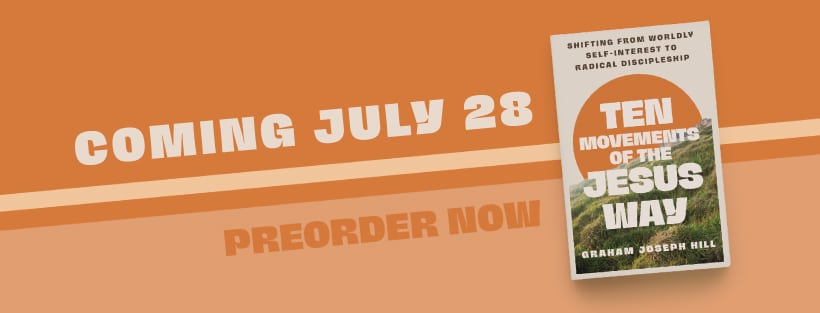
Graham Joseph Hill. Ten Movements of the Jesus Way: Shifting from Worldly Self-Interest to Radical Discipleship. InterVarsity Press, July 2026. Preorder here: https://www.ivpress.com/ten-movements-of-the-jesus-way
About This Series
This post is part of The Jesus Way, a weekly blog series exploring the ten movements that shape a life of following Jesus. Each movement traces a path the Gospels invite us to walk: from the patterns the world rewards toward the life Jesus actually lived and taught.
The series builds toward the release of my book, The Ten Movements of the Jesus Way, coming from InterVarsity Press on 28 July 2026. If you’d like to follow the full journey, you can subscribe to receive each new post as it’s published.
Preorder “The Ten Movements of the Jesus Way” here: https://a.co/d/004aPGwi