The Jesus Way · Movement 1 · From Material Success to Spiritual Riches
The One Who Got Away
There’s a particular kind of sadness that comes from choosing something you already know is second-best.
You see it in the person who stays in a career they have outgrown because the salary is too good to walk away from. You see it in the couple who know the relationship is dying but can’t face the upheaval of honesty. You see it in the student who abandons a calling in the arts for a “practical” degree, carrying grief for years afterward that they can never quite name.
It’s the sadness of someone who has glimpsed something luminous and true, and turned away from it. They turned away freely. No one forced them. And that is what makes it so devastating. They saw the better thing. They recognized it. And they couldn’t bring themselves to reach for it, because reaching for it would have required letting go of something else.
This is the sadness at the center of one of the most haunting stories in the Gospels. A man comes to Jesus full of eagerness and hope. He leaves full of sorrow. And somewhere between his arrival and his departure, something breaks open that has never stopped echoing through the centuries.
A Man Runs to Jesus
Mark tells the story with characteristic urgency. Jesus is setting out on a journey when a man runs up to him and kneels in the road. The detail matters. This man isn’t strolling. He isn’t sauntering over for a philosophical discussion. He’s running. He’s desperate. He’s on his knees before Jesus has time to greet him.
“Good Teacher,” he says, “what must I do to inherit eternal life?”
It’s a beautiful question, and an honest one. This man wants to live. He wants the kind of life that lasts, the kind that death can’t extinguish. He has heard something in Jesus’s teaching, or seen something in Jesus’s presence, that has made him believe this rabbi from Nazareth might have the answer.
Jesus’s first response is curious. “Why do you call me good? No one is good except God alone.” Scholars have debated this reply for centuries. Is Jesus deflecting the compliment? Is he testing the man’s theology? I think he’s doing something simpler and more profound. He’s slowing the conversation down. The man has come in a rush, full of urgency, and Jesus is pressing pause. He’s saying: Before we go any further, let’s be clear about what we’re talking about. Goodness belongs to God. If you’re looking for the good life, you’re looking for God’s life. Are you sure you want that?
Then Jesus names the commandments. “You know the commandments: Don’t murder. Don’t commit adultery. Don’t steal. Don’t bear false witness. Don’t defraud. Honor your father and mother.”
The man’s answer is immediate and confident: “Teacher, all these I have kept since my youth.”
And here is where the story turns. Here is where everything changes.
Mark writes: “Jesus, looking at him, loved him.”
What Jesus Saw
I want to stay with that sentence for a moment, because it’s one of the most extraordinary lines in the entire New Testament.
Jesus looked at him and loved him.
Mark is the sparest of the Gospel writers. He doesn’t waste words. He doesn’t often pause to describe Jesus’s emotions. But here he stops the narrative to tell us something about what was happening inside Jesus as he looked at this man kneeling in the road. And what was happening was love.
This is critical. What follows next will sound harsh if we miss this. Jesus is about to say something that will break this man’s heart. And he says it out of love.
What did Jesus see when he looked at this man? He saw someone who had done everything right. Someone who had kept all the rules, checked all the boxes, followed every commandment since boyhood. By any external measure, this man was a success. He was devout, moral, wealthy, and earnest. The other disciples would have been impressed. The religious authorities would have approved. His neighbors would have admired him.
But Jesus saw something else. Jesus saw a man who was imprisoned by the very thing everyone else envied. He saw a man whose wealth had become a cage, whose possessions had become a weight, whose abundance had become the single greatest obstacle between him and the life he was asking about. Everyone else saw a man who had everything. Jesus saw a man who was held captive by everything he had.
This is what love does. Love sees beneath the surface. Love sees past the impressive exterior to the trapped and aching person underneath. A friend will compliment your success. A good teacher will challenge your assumptions. But only someone who loves you will name the thing that is killing you and invite you to let it go.
The One Thing You Lack
“You lack one thing,” Jesus says. “Go, sell what you own, and give the money to the poor, and you’ll have treasure in heaven; then come, follow me.”
One thing. After a lifetime of obedience, after decades of faithfulness, after keeping every commandment in the book, there’s still one thing. And that one thing is the thing the man can’t do.
Notice how specific Jesus’s instruction is. He doesn’t say, “Try to be a little more generous.” He doesn’t say, “Consider adjusting your relationship with money.” He doesn’t say, “Reflect on your priorities and see if there’s room for improvement.” He says sell. Everything. Give it to the poor. And then follow me.
Why? Why this particular ask for this particular man?
Because Jesus understood that every person has a unique point of attachment, a specific place where the self clings most tightly to something that has become a substitute for God. For this man, that place was his wealth. His possessions were the thing standing between him and freedom. They were the idol he didn’t know he was worshipping, the god he served without realizing he had a god other than God.
This is important to understand, because it means Jesus isn’t issuing a universal command to liquidate every asset. He’s performing surgery. He’s identifying the precise tumor that is threatening this man’s spiritual life, and he’s saying: this must come out. The diagnosis is specific. The prescription is personal. And it’s devastating precisely because it’s accurate.
The man’s face falls. Mark uses a Greek word, stugnasas, that carries the image of a sky going dark with clouds. The light drains from his expression. And he walks away grieving, because he had many possessions.
He walks away. He walks away from Jesus. He walks away from the invitation to a life of freedom and fullness and eternal significance. He walks away from love itself, looking him in the eyes. And he does it because he can’t let go of his stuff.
He Went Away Sad
The detail that always stops me is the grief. He went away sad.
He didn’t go away angry. He didn’t go away indignant. He didn’t go away arguing or rationalizing or telling himself that Jesus was being unreasonable. He went away sad. He knew. He knew he was choosing the lesser thing. He knew he was walking away from life. And he couldn’t help himself.
There’s something profoundly human about this moment. We have all been here. We have all stood at a crossroads where we could see the better path clearly and chosen the familiar one because the cost of change felt too high. We have all walked away sad.
Maybe it was a relationship we knew we should end but couldn’t face the loneliness. Maybe it was a job we knew was eroding our soul, but the paycheck kept us tethered. Maybe it was a habit we knew was slowly destroying us but the thought of life without it felt unbearable. Maybe it was an identity we’d built over decades, a version of ourselves that everyone recognized and affirmed, and the thought of dismantling it felt like dying.
The rich young ruler’s sadness is the sadness of anyone who has ever chosen security over transformation. It’s a heavy, private grief. And it’s one of the most common human experiences there’s.
What makes the story so painful is that we never hear from this man again. Mark doesn’t give him a name. He appears from the crowd, kneels before Jesus, receives the most loving and terrifying invitation of his life, and disappears. The Gospel never tells us whether he eventually reconsidered. Whether, lying awake that night in his beautiful home surrounded by all his beautiful things, he felt the weight of what he had refused. Whether weeks or months or years later, he came back.
We don’t know. And that open ending is part of the story’s power. Because it means the story isn’t finished. It means the question Jesus asked this man is still hanging in the air, still waiting for an answer. Still waiting for our answer.
The Eye of a Needle
After the man leaves, Jesus turns to his disciples. “How hard it’ll be for those who have wealth to enter the kingdom of God!”
The disciples are perplexed. In first-century Jewish culture, wealth was widely understood as a sign of God’s blessing. If a rich man couldn’t enter the kingdom, who could? Their confusion reveals how deeply the assumption ran: prosperity equals divine approval.
Jesus presses the point with one of the most vivid images in all his teaching: “It’s easier for a camel to go through the eye of a needle than for someone who is rich to enter the kingdom of God.”
Over the centuries, various interpreters have tried to soften this saying. Some have suggested that the “eye of the needle” was a small gate in the Jerusalem wall, through which a camel could squeeze if it knelt and had its baggage removed. It’s a lovely image, and almost certainly an invention of later commentators who found Jesus’s original image too alarming. There’s no historical evidence for such a gate. Jesus means what he says. He’s describing something impossible. A camel through the eye of a sewing needle. It can’t be done.
The disciples are astounded. “Then who can be saved?” they ask. And Jesus gives an answer that reframes everything: “For mortals it’s impossible, but not for God; for God all things are possible.”
This is the pivot of the whole story. Jesus isn’t saying that wealthy people are damned. He’s saying that the grip of wealth on the human heart is so powerful, so deep, so tenacious, that no amount of willpower or moral effort can break it. You can’t free yourself from the thing that owns you. Only God can do that. The liberation Jesus offers requires a power beyond our own.
And this, paradoxically, is the good news hidden inside the hard news. Because it means the invitation to let go is also an invitation to receive. It means that the hands Jesus asks us to open are the same hands God wants to fill. The emptiness that terrifies us is the very space where grace enters.
The Things We Can’t Imagine Releasing
I have spent a long time with this story, and I have come to believe that its power lies in one uncomfortable truth: every one of us has a version of the rich young ruler’s wealth. Every one of us has something we can’t imagine releasing.
For some of us, it’s literal financial wealth. We live in a culture that has made accumulation a sacrament. The economy depends on our desire for more. Advertising exists to manufacture dissatisfaction, to make us feel that what we have is never enough. And the result is that many of us, even those who would call themselves people of faith, have built our lives around the pursuit and protection of financial security in ways we rarely examine.
We give to charity, yes. We tithe, perhaps. But we do so from our surplus, from the edges, from the portion we have decided we don’t need. The core remains untouched. The foundation is still money. And if someone were to suggest that we sell everything and give it to the poor, we would react with the same stunned silence as the disciples.
But for many of us, the rich young ruler’s attachment takes other forms.
There’s the attachment to success. The need to be seen as competent, accomplished, impressive. The way our identity has become fused with our achievements so thoroughly that we can’t separate who we’re from what we have done. If you took away the degrees, the title, the track record, the reputation, would you know who you were?
There’s the attachment to control. The need to manage every outcome, to eliminate uncertainty, to make sure nothing goes wrong. This one is subtle because it disguises itself as responsibility. But underneath the planning and the worrying and the contingency strategies, there’s often a deep terror of helplessness, a refusal to trust that God might be at work in the chaos.
There’s the attachment to being right. The need to win every argument, to hold the correct position on every issue, to defend our views with the ferocity of someone guarding a treasure vault. For some of us, our theological certainty is the wealth we can’t imagine parting with. We would give up money before we would give up being right.
There’s the attachment to busyness. The packed schedule, the full inbox, the constant sense of being needed and indispensable. Busyness makes us feel important. It gives us a reason not to stop and face the silence. And the thought of clearing the calendar, of stepping off the treadmill, of simply being still, fills us with the same dread the rich young ruler must have felt when Jesus said sell.
And there’s the attachment to our wounds. This is perhaps the hardest one to name. Some of us have been carrying our pain for so long that it has become part of our identity. Our story of victimhood, our narrative of injustice, our catalogue of grievances: these are possessions too. And sometimes Jesus asks us to let go of the very suffering we have been clutching to our chest, because holding onto it is keeping us from the life he wants to give us.
The question, in every case, is the same: What’s the one thing? What’s the thing Jesus would look at with love and say, “This has to go”?
The Loving Gaze
I want to return to that extraordinary sentence one more time: Jesus, looking at him, loved him.
Because if we’re going to ask the terrifying question of what Jesus would ask us to sell, we need to remember the posture from which he asks it. He asks from love. He asks because he sees us, truly sees us, and what he sees moves him. He isn’t trying to punish us or deprive us. He’s trying to set us free.
I think many of us have spent years hearing the voice of religion as a voice of demand: Do more. Try harder. You’re not enough. Give up the things you love. And we have responded either with exhausted compliance or bitter rebellion. But the voice in this story is a different voice. It’s the voice of someone who looks at you with full knowledge of who you are, what you are carrying, and what’s slowly killing you, and says, with tenderness: Let it go. You don’t need it. I have something better.
The spiritual tradition calls this the loving gaze of Christ. It’s the experience of being fully known and fully loved in the same moment. And it’s from within that gaze that the hardest invitations become bearable. Because when you know you are loved, truly loved, the things you have been clutching so tightly begin to lose their power. You begin to realize that what you were holding onto was a substitute for the love you craved.
The rich young ruler couldn’t receive this. He walked away from the love because the cost of receiving it felt too high. But the love didn’t stop. The gaze didn’t turn away. I believe Jesus watched him walk down that road with the same love in his eyes that was there when the man knelt before him.
And I believe that same gaze is on you right now, as you read these words. Whatever you are holding onto, whatever you are terrified to release, Jesus is looking at you with love. He isn’t angry. He isn’t impatient. He sees the cage you are in, and he’s offering you the key.
A Practice for the Week
Last week, I invited you to spend seven days noticing where your money, time, and attention flow. If you did that, you may already have a sense of what holds the deepest grip on your life.
This week, I want to invite you into a different kind of practice.
Sit in silence for twenty minutes each day this week and ask one question: What’s the one thing I can’t imagine releasing?
Don’t rush toward an answer. Don’t try to fix anything. Simply sit with the question and let it do its work.
You might find that the answer comes immediately, with a clarity that takes your breath away. You might find that it shifts from day to day, each sitting revealing a different layer. You might find that the question itself brings up resistance, a desire to change the subject, a sudden need to check your phone. Pay attention to the resistance. The thing you least want to look at is often the thing Jesus is gently pointing toward.
At the end of each sitting, imagine Jesus looking at you. Imagine his eyes full of the same love Mark describes in this story. And say to him, honestly, whatever is true: “I’m afraid to let go.” Or: “I don’t know if I can.” Or: “Help me want to want this.”
You don’t need to sell everything this week. You don’t need to make a dramatic gesture. You simply need to stand in the place where the rich young ruler stood and stay a little longer than he did. You need to remain in the presence of the one who sees you and loves you, and let that love begin its slow, patient work.
Because here is what I have learned from this story: the invitation never expires. The man walked away, but Jesus didn’t withdraw the offer. The road back to that crossroads is always open. And every time we return to it, the same loving eyes are waiting.
A Question for Reflection
Here is the question to carry with you this week:
If Jesus were to look at you with love and say, “You lack one thing,” what do you think that one thing would be?
I would love to hear what surfaces for you. What did you notice as you read this story? Where did you feel recognition or resistance? Share your reflections in the comments or pass this post along to a friend who might be wrestling with the same question.
Next week, we continue in Movement 1 with “Consider the Lilies,” where we will explore what Jesus taught about anxiety, provision, and the possibility of trusting God with the very things we’re most afraid to lose. I hope you’ll join me.
Grace and peace to you on the journey.
About This Series
This post is part of The Jesus Way, a weekly blog series exploring the ten movements that shape a life of following Jesus. Each movement traces a path the Gospels invite us to walk: from the patterns the world rewards toward the life Jesus actually lived and taught.
Movement 1, From Material Success to Spiritual Riches, asks what happens when we loosen our grip on wealth, status, and accumulation and discover the abundance God has been offering all along.
The series builds toward the release of my book, The Ten Movements of the Jesus Way, coming from InterVarsity Press on 28 July 2026. If you’d like to follow the full journey, you can subscribe to receive each new post as it’s published.
Preorder “The Ten Movements of the Jesus Way” here: https://a.co/d/004aPGwi
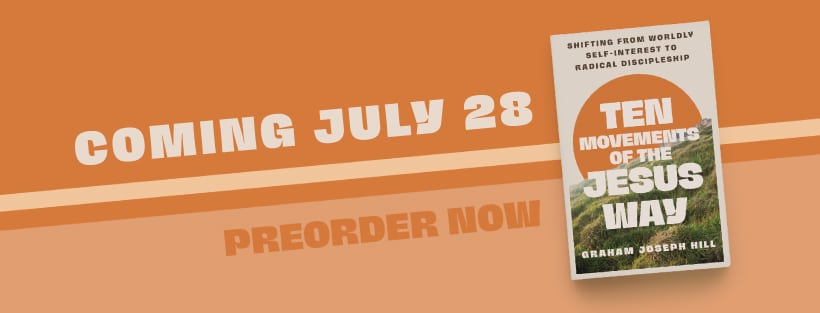
New Book
Graham Joseph Hill. Ten Movements of the Jesus Way: Shifting from Worldly Self-Interest to Radical Discipleship. InterVarsity Press, July 2026. Preorder here: https://www.ivpress.com/ten-movements-of-the-jesus-way