The Jesus Way · Movement 1 · From Material Success to Spiritual Riches
3 a.m.
There’s an hour of the night when the mind turns predatory.
You know the hour. You were sleeping, or almost sleeping, and then something shifts. A thought surfaces. It might be small at first: a bill you forgot to pay, an email you should have sent. But the thought doesn’t stay small. It sends roots downward, finds older thoughts, and they tangle together in the dark until what started as a single worry has become a thicket of dread.
By 3 a.m., the ceiling above your bed has become a screen on which your mind projects its worst possibilities. The mortgage. The diagnosis. The child who isn’t returning your calls. You lie there in the dark, heart beating too fast, running calculations you can’t solve, rehearsing conversations that have not happened, bracing for catastrophes that may never arrive.
This is anxiety. And if you’ve never experienced it, you are among a fortunate few. For the rest of us, it’s as familiar as breathing, the background hum of modern life, a low-grade fever that never quite breaks. We medicate it, meditate on it, scroll through our phones to distract ourselves from it. And still it comes, pulling us back to the question that has haunted human beings since the beginning of time: Will I be okay?
Two thousand years ago, on a hillside in Galilee, Jesus looked at a crowd of people gripped by that question and said something extraordinary. He told them to look at the flowers.
The Teaching on the Hill
The passage comes from the Sermon on the Mount. Jesus has been speaking about money and possessions, about the impossibility of serving two masters. And now, as if he can see the worry lines deepening on the faces before him, he turns to address the anxiety that his teaching has stirred.
“Therefore, I tell you, don’t worry about your life, what you’ll eat or what you’ll drink, or about your body, what you’ll wear. Isn’t life more than food, and the body more than clothing?”
He points upward. “Look at the birds of the air; they neither sow nor reap nor gather into barns, and yet your heavenly Father feeds them. Are you not of more value than they?”
He points to the ground. “And why do you worry about clothing? Consider the lilies of the field, how they grow; they neither toil nor spin, yet I tell you, even Solomon in all his glory was not clothed like one of these. But if God so clothes the grass of the field, which is alive today and tomorrow is thrown into the oven, will he not much more clothe you, you of little faith?”
And then the instruction: “Therefore don’t worry, saying, ‘What will we eat?’ or ‘What will we drink?’ or ‘What will we wear?’ For it’s the Gentiles who strive for all these things; and indeed, your heavenly Father knows that you need all these things. But strive first for the kingdom of God and his righteousness, and all these things will be given to you as well.”
He closes with a sentence that has the quiet force of a proverb: “So don’t worry about tomorrow, for tomorrow will bring worries of its own. Today’s trouble is enough for today.”
What This Teaching Is and Isn’t
Before we go further, we need to address something that many readers feel when they encounter this passage: irritation.
Because on the surface, this can sound like naive optimism. It can sound like the spiritual equivalent of a motivational poster. And for anyone who has ever lain awake calculating whether they can afford groceries and rent in the same month, or waited for biopsy results, the instruction “don’t worry” can feel as helpful as telling a drowning person to relax.
So let’s be clear about what Jesus is doing here. He’s speaking to people who were genuinely poor. The crowds on that hillside were largely peasant farmers, day laborers, and subsistence workers living under Roman occupation and crushing taxation. When Jesus says, “don’t worry about what you’ll eat,” he isn’t speaking from privilege to people with full pantries. He’s speaking to people for whom the worry was immediate and visceral. And he doesn’t dismiss the need. “Your heavenly Father knows that you need all these things,” he says. He reframes the response to it.
The Greek word translated as “worry” is merimnaō, from the root merizo, to divide. Anxiety, in this understanding, is a fracturing of the self. It’s what happens when your mind scatters into a dozen possible futures, none of which you can control, and your soul is torn between them. You are here, in this moment, but your mind is everywhere else.
Jesus is naming this fracturing. And he’s offering an alternative: a gathered life, organized around a single center, in which your attention comes home to the present moment and to the God who meets you there.
The Curriculum of Birds and Flowers
What I love about this teaching is the classroom Jesus chooses. He doesn’t send his students to the synagogue or the library. He sends them outdoors. Look at the birds. Consider the lilies.
The birds of the air are constantly active. They build nests, hunt for food, and feed their young. Jesus isn’t praising laziness. He’s seeing the absence of existential dread in creation. Birds do the work of being birds, fully, instinctively, with their whole selves. What they don’t do is lie awake at night agonizing over whether there will be worms tomorrow.
The lilies are even more striking. They do nothing at all, at least from a human productivity standpoint. They don’t toil. They don’t spin. They simply grow. They receive sunlight, rain, and soil, and they become beautiful. Their beauty is effortless, unearned, and, Jesus insists, so extravagant that Solomon at the height of his royal splendor couldn’t compete with it.
There’s something subversive happening here. Jesus is comparing the anxiety-driven striving of human beings with the unhurried unfolding of a wildflower, and he’s saying that the wildflower is closer to the truth. The lily doesn’t earn its beauty. It receives it. The lily doesn’t manufacture its own life. It participates in a life that is given.
And here is the implication: if God gives this much attention and care to a flower that blooms for a day and is gone, what makes you think God has forgotten about you? The argument is from the lesser to the greater, a form of reasoning Jesus often uses. If God provides for birds, will God not provide for you? If God adorns grass, will God not care for you? The answer Jesus expects is obvious: Of course. The question is whether we believe it.
The Fear Beneath the Fear
This is where the passage moves from comfort to confrontation. Because Jesus doesn’t simply offer reassurance. He asks a question that probes deeper than the surface worry.
“Can any of you by worrying add a single hour to your span of life?”
The answer, obviously, is no. Worry has never lengthened a life, healed a disease, paid a bill, or solved a problem. Worry doesn’t protect us. It only steals the present while failing to secure the future.
But knowing this doesn’t stop us from worrying. And that tells us something important: anxiety isn’t primarily a rational problem. It’s a spiritual one. It lives below the level of logic, in the place where our deepest beliefs about reality are formed.
I’ve come to believe that most of our anxiety, when you trace it to its root, isn’t really about the thing we think it’s about. Beneath all the specific anxieties is a deeper fear, and it usually sounds something like this:
I’m on my own. No one is watching out for me. If I don’t hold everything together, it will all fall apart. And I’m not enough to hold it together.
This is the fear beneath the fear. It’s the belief that the universe is indifferent, that we’re ultimately alone, that there’s no hand beneath us if we fall. In the language of faith, it’s a crisis of trust. And it’s this crisis that Jesus is addressing.
When he says, “you of little faith,” the Greek word is oligopistoi. It’s tender, almost affectionate, the kind of word you would use with a child who is frightened of the dark. Jesus isn’t scolding. He’s naming the condition: you have a small trust. You believe in God, yes, but you aren’t sure God is paying attention to you. You know the theology of providence, but at 3 a.m., when the fears start playing, the theology feels very thin.
Jesus sees this. And his response is to point to a lily. Look. See how it’s cared for. See how it’s clothed. See how it’s held within a web of provision so intricate, so faithful, so extravagant that even a king’s wardrobe can’t match it. And then let yourself wonder: What if that same care is holding you?
The Worthiness Question
There’s a line buried in this passage that I think we pass over too quickly. Jesus says, “Are you not of more value than they?”
He’s asking his listeners to consider their own worth. And for many of us, this is where the teaching becomes most difficult. Because the deepest root of anxiety, the taproot from which all the other roots grow, is often a secret conviction that we’re not worth caring for.
This may sound strange. Most of us don’t walk around consciously thinking, “I’m worthless.” But the belief operates below the surface, expressed in the relentless drive to earn, prove, achieve, and accumulate. If we were truly convinced of our value, would we work ourselves to exhaustion trying to demonstrate it?
The anxiety epidemic in our culture is, at its core, a worthiness crisis. We measure our value by our output. We earn our right to rest by first earning enough to deserve it. And when the output slows, when the performance falters, the anxiety rushes in like water through a cracked dam.
Jesus is speaking into this. He’s saying: You are valuable. Your value isn’t something you manufacture. It’s something you already possess, given to you by the same God who gave beauty to the lilies and food to the birds. You were worth caring for before you accomplished anything, and you’ll be worth caring for after all your accomplishments have been forgotten.
This is a staggering claim. And anxiety, by its very nature, can’t hear it. Because anxiety operates on the assumption that everything depends on us. And the gospel operates on the assumption that everything depends on God.
Trust as a Spiritual Practice
How do we embrace trust? The honest answer is slowly. And with practice.
Trust isn’t a feeling that arrives one day and solves everything. Trust is a practice, a discipline, a way of training the soul to rest in what it can’t control. It’s something you do with your body, your time, and your attention, day after day, until it begins to reshape the deep architecture of your inner life.
The contemplative tradition has always understood this. The desert fathers and mothers who retreated to the Egyptian wilderness in the fourth century did not go there because they had conquered anxiety. They went because they were drowning in it. The silence and solitude were medicine for spiritual illness. In the stillness, all the fears and compulsions that daily life had kept at bay came roaring to the surface. And there, in the raw encounter between the terrified self and the living God, trust was forged.
We don’t need to move to the desert. But we do need spaces of stillness where the forging can happen. Anxiety thrives on speed. It feeds on distraction. It grows stronger every time we reach for the phone instead of sitting with the discomfort. And it weakens, slowly but surely, every time we choose to stay present, to breathe, to let the fear surface without running from it, and to place it, consciously, in the hands of God.
This is what Jesus means when he says, “Strive first for the kingdom of God.” He’s talking about the reorientation of attention. When your mind begins to scatter into a thousand anxious futures, bring it back. Bring it home to the presence and the provision and the love of God, available to you right now, in this breath, in this moment.
This isn’t a technique for eliminating anxiety. It’s a posture for living with it faithfully. The life of faith doesn’t immunize us against fear. It gives us a place to put it.
The Anxiety of Abundance
I want to name something particular to our moment in history. Many of us reading this aren’t worried about where our next meal will come from. We have pantries full of food, closets full of clothing, roofs over our heads, and devices in our pockets that connect us to the entire accumulated knowledge of humanity. And we’re anxious beyond anything previous generations could have imagined.
This is one of the great paradoxes of affluent societies. The more we have, the more we must worry about. The more we accumulate, the more we fear losing. Our abundance has not cured our anxiety. In many ways, it has deepened it.
Anxiety is the emotional fruit of misplaced treasure. When your security is built on things that moths can eat, and rust can corrode, and thieves can steal, of course, you are anxious. And no amount of accumulation will make the foundation solid, because the problem isn’t that you don’t have enough. The problem is that you are building on the wrong ground.
Jesus offers a different ground. He offers the love of a God who knows what you need before you ask, who clothes the lilies and feeds the sparrows. And he invites you to build there instead.
A Meditation on Provision
I want to offer a brief meditation. You might read it once through and then return to it slowly.
Think of a time when you were provided for in a way you did not expect.
It might have been dramatic: a check that arrived the day before the bill was due, a stranger’s kindness that changed the course of a difficult week. Or it might have been quiet: the realization, looking back, that you got through a season you were certain would break you.
Hold that memory. Let it become vivid.
Now ask yourself: Did you orchestrate that provision? Did your worrying make it happen? Or did it arrive from somewhere outside your control, as a gift?
Now, think of the thing you are most worried about right now.
Name it. Let it sit in front of you. Feel the weight of it. And then, gently, set it beside the memory of provision. Let them exist in the same space. The worry and the evidence of care. The fear and the faithfulness.
And ask: What if the same God who provided then is providing now, in ways I can’t yet see?
This is the practice of trust. It doesn’t pretend the worry isn’t real. It simply places the worry in a larger frame: the frame of a God who has been faithful before and can be faithful again.
Today’s Trouble Is Enough for Today
The last line of the passage is, I think, the most practical thing Jesus ever said: “Don’t worry about tomorrow, for tomorrow will bring worries of its own. Today’s trouble is enough for today.”
There’s a wry humor here that we sometimes miss. Jesus isn’t promising a trouble-free life. He’s acknowledging that trouble is plentiful. You’ll never run out. So why borrow tomorrow’s trouble today?
This is the wisdom of the most grounded and humankind. It’s the wisdom of twelve-step programs, which teach people to take life one day at a time. It’s the wisdom of every parent who has ever told a frightened child, “We don’t have to figure that out right now.” And it’s the wisdom of the lilies. A lily doesn’t bloom tomorrow; bloom today. It blooms today. It receives today’s sunlight. It drinks today’s rain. It unfolds at the pace of today.
Jesus is inviting his followers to live in day-sized pieces. To receive today as a gift. To trust that tomorrow’s grace will arrive with tomorrow’s trouble. And to stop carrying the weight of a future that has not yet been born.
A Practice for the Week
This week, I want to offer a daily practice rooted in the passage.
Each morning, before you check your phone, before you open your email, before the day’s demands begin their pull, step outside.
It doesn’t matter whether you have a garden or a patch of sky visible from your window. Find something living: a tree, a bird, a weed pushing through a crack in the pavement. Look at it long enough for your breathing to slow.
And then say, aloud or in your heart:
“God, you care for this. You care for me. Today’s trouble is enough for today. Help me stay here, in this day, with you.”
Then, at one point during the day when you notice anxiety rising, pause. Take three slow breaths. Return to the image of the lily. You don’t have to solve the future. You must be faithful today.
At the end of each day, before sleep, write down one thing you were provided with that you did not manufacture yourself. It might be a kindness from a colleague, an unexpected moment of beauty, or simply the fact that you made it through. Let the day’s evidence of provision accumulate over the week. By the seventh day, you’ll have a small record of faithfulness, a trail of lilies marking the path behind you.
Questions for Reflection
As you sit with this passage, let these questions accompany you:
Where does anxiety have the strongest grip on my life right now? What is the specific worry that returns most often?
When I trace that anxiety to its root, what is the deeper fear underneath? What am I afraid of?
Can I name a time when God provided for me in a way I did not expect? What does that memory say about the present worry?
What would it look like to live today, just today, as if I believed I was held?
I would love to hear where these questions take you. What surfaced as you read? Share your reflections in the comments or send this to someone who is carrying a heavy load of worry right now. They might need to hear about the lilies.
Next week, we close out Movement 1 with “The Parable of the Rich Fool,” the story of a man who built bigger barns and never got to use them. We’ll explore what it means to be “rich toward God.” I hope you’ll join me.
Grace and peace to you on the journey.
About This Series
This post is part of The Jesus Way, a weekly blog series exploring the ten movements that shape a life of following Jesus. Each movement traces a path the Gospels invite us to walk: from the patterns the world rewards toward the life Jesus actually lived and taught.
Movement 1, From Material Success to Spiritual Riches, asks what happens when we loosen our grip on wealth, status, and accumulation and discover the abundance God has been offering all along.
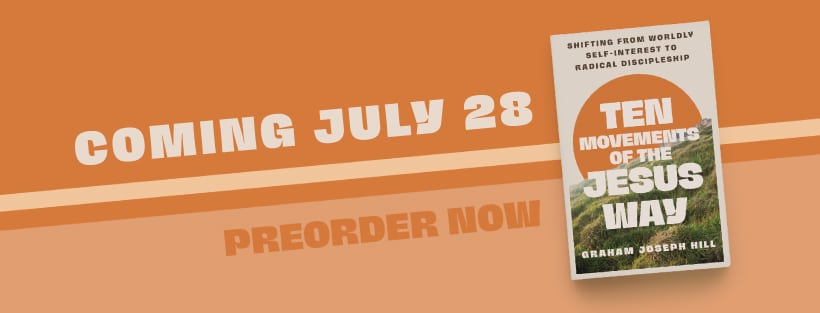
The series builds toward the release of my book, The Ten Movements of the Jesus Way, coming from InterVarsity Press on 28 July 2026. If you’d like to follow the full journey, you can subscribe to receive each new post as it’s published.
Preorder “The Ten Movements of the Jesus Way” here: https://a.co/d/004aPGwi
New Book
Graham Joseph Hill. Ten Movements of the Jesus Way: Shifting from Worldly Self-Interest to Radical Discipleship. InterVarsity Press, July 2026. Preorder here: https://www.ivpress.com/ten-movements-of-the-jesus-way