How the Majority World Is Reshaping Christianity
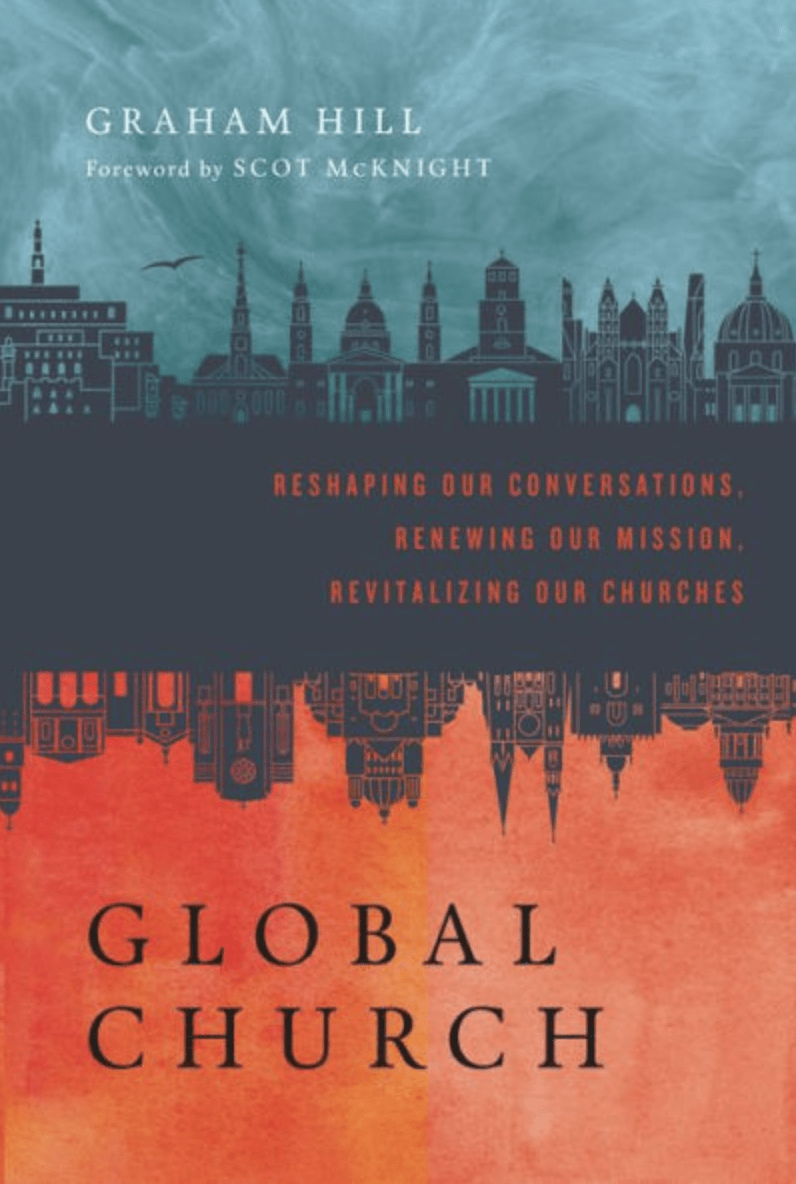
A few years ago, I sat in a church hall in a country town in New South Wales while someone I’ll call Val counted the heads in the room. Val got to nineteen, then told me, with no bitterness at all, that when Val was a child, this same room held two hundred people, there were three services on a Sunday, and the Sunday school kept running out of chairs. Seeing her pain was heartbreaking, and I was genuinely moved. That story gets told a lot in this country, and it usually gets told as though it’s the story of Christianity itself. The faith rose, the faith is falling, and we’re sitting in the back row watching the last of it go.
On that very same Sunday, though, churches in Lagos and Nairobi and Seoul and São Paulo were packed to the doors and spilling into the street. Full of Nigerians and Kenyans and Koreans and Brazilians whose faith and theology are their own, and who together make up the overwhelming majority of Christians alive today. Christianity is booming in those contexts, and that’s something worth celebrating and learning from. So here’s the question worth sitting with. If the center of Christianity has moved, and it has, what does that ask of those of us who spent our whole lives assuming we stood on it?
The Numbers Turned Inside Out
In 1900, there were around 558 million Christians in the world, and 381 million of them lived in Europe. Two of every three Christians on earth, on one small continent. By 2010, there were about 2.3 billion, and the distribution had turned inside out. Africa went from 10 million to 493 million, Asia from 22 million to 352 million, and Latin America from 62 million to 544 million. Europe’s share fell from two-thirds to roughly a quarter. Notice the dramatic shift happening in World Christianity today.
Take China. In 1949, when the foreign missionaries were expelled, Protestant churches there had around a million members. By 2010, the estimate was 58 million. Mao believed religion in China could be ended and thought the job was done. The church Mao thought was buried grew fastest precisely when the missionaries were gone, and the buildings were shut. The Spirit of Christ grew the very church Mao thought he’d extinguished
This Faith Has Always Been on the Move
If that’s disorienting, take comfort from history, because Christianity has moved its center before. That’s the normal pattern of this faith, and the five hundred years we’ve just lived through are the exception. The church began in Jerusalem, a provincial city on the edge of an empire. Within a generation, the energy had moved to Antioch, then out into the Greek-speaking Mediterranean, then west to Rome and North Africa. Some of the greatest theologians of the early church were African. Augustine was a Berber from what’s now Algeria, Tertullian and Cyprian came from Carthage, and Athanasius was Egyptian. The faith went east too, reaching the Tang capital at Xi’an by 635, while Ethiopia’s church has been continuous since the fourth century. We follow a God who is always reshaping the church and showing divine power and grace in new and surprising places, often outside the center.
One detail steadies me. A stone stele still stands in Xi’an, erected in 781, recording the arrival of that eastern church. The community it commemorated faded almost entirely, and the stone lay buried for eight hundred years. Fourteen centuries on, we’re discussing whether China will soon hold more Christians than any nation on earth. History runs longer than our anxiety. And the God we serve has plans and ways that are beyond ours, so we can rest and abide in the Vine.
The God Who Speaks Your Language
Let me make a claim stronger than sociology. What we’re watching has the shape of the thing from the beginning. I’ve noticed how this pattern occurs throughout the Bible.
God calls Abram in Genesis twelve, and the promise carries a horizon inside it: through you all the families of the earth will be blessed. The Hebrew is mishpechot ha’adamah, the clans of the whole inhabited earth. The nations were written into the founding promise on day one. Right from the start, Yahweh has a desire for all peoples and nations.
Then comes Pentecost. The Spirit falls, the disciples begin to speak in other tongues, glōssais, and the crowd hears the wonders of God in their own native languages. Luke lists them: Parthians, Medes, Elamites, Cappadocians, Egyptians, Cretans, and Arabs. The list is the point. God could have given everyone one holy language, a single sacred tongue for a single sacred people. It would have been tidier, and every empire in history has tried it. What God does is multiply the gospel into every language in the room. Babel scattered people through confused speech, and at Pentecost, God gathers them while keeping every language intact. The gospel arrives in your mother tongue, inside your culture. No matter what language you speak, no matter what culture or ethnicity you come from, God is continually reaching out to you and to those you dwell among and love.
Then in Acts fifteen the church holds its most consequential meeting, deciding whether Gentile believers must first become Jewish. The council says no. Gentiles come in as Gentiles. Luke’s phrase is remarkable: edoxen tō pneumati tō hagiō kai hēmin, it seemed good to the Holy Spirit and to us. Sit with that phrase for a moment. The Spirit was moving dynamically, and God’s people were catching the divine passion and vision. A group of Jewish believers decided, under the Spirit, that their own culture was no price of admission to the family of God.
And there’s a line in Ephesians three that belongs on the wall of every theological college in the West. Paul prays that the church may have power, together with all the saints, to grasp how wide and long and high and deep is the love of Christ. Sun pasin tois hagiois. Comprehending the love of Christ is a group project, and the group is the whole church, everywhere. My grasp of the love of God is limited by the smallness of my company. If the only Christians I read look like me and read the Bible with my assumptions, my understanding of Christ has a ceiling on it, and I put it there myself. So, we need a diversity of peoples, languages, cultures, gender, and abilities to grasp the fullness of the love of God and to know what it truly means to be God’s beloved.
If you’d like to sit with this further, I go deeper into it on The Graham Joseph Hill Podcast, available wherever you get your podcasts.
Three Honest Objections
I’d rather raise the objections myself than pretend they aren’t there. First, numbers count adherents, and adherents are a long way from disciples. Some of the growth is birth rate as much as conversion, and some is nominal in exactly the way Western Christianity was nominal in 1955, when the churches of Sydney and Manchester filled up because everybody came. The skepticism we apply to old Western statistics applies to the new numbers too. We need to be cautious when examining the numbers and claims.
Second, growth and health are separate things. The prosperity gospel has spread widely, telling poor people in its harder forms that their poverty is a spiritual failure and that God will make them rich if they hand over money they can’t spare. Imagine the damage done by such misleading spiritual claims. None of this is a Western observation imposed from outside. Majority World theologians write about it at length, often more bluntly than I would.
Third, and this is the one I watch in myself, romanticizing the Majority World church is its own form of condescension. It’s too easy for us to exoticize and romanticize others, and that can be its own form of colonization and paternalism. Treat African and Asian Christians as spiritual medicine for tired Western believers, and you’ve turned them into a resource for your own renewal, which is the old colonial move wearing new clothes.
So where does that leave the argument? On Paul’s line, and nowhere else. Together with all the saints. I need the whole church to understand Christ, and for five centuries the Western church has tried it with a fraction of the family in the room. We need all the people of God, in all their diversity, vibrancy, and beauty, coming together to glorify God, spread the Gospel of Jesus Christ, and move out in the power of the Spirit. That claim survives every objection above, because it was never about who’s more faithful. It’s about what any of us can see from where we’re standing.
What to Actually Do This Week
This conversation generates a great deal of agreement and very little change, so let me be specific. Start with your bookshelf. I know I’ve had to examine my books closely! Buy one book by a Majority World or First Nations theologian and read it slowly. For Africa, try Kwame Bediako, Mercy Amba Oduyoye, or Emmanuel Katongole. For Asia, Kōsuke Koyama or Vinoth Ramachandra. For Latin America, C. René Padilla or Ruth Padilla DeBorst. And read them the way you’d read a theologian, never as a travel diary. Read them with the same seriousness and scrutiny you read all theology and literature. When we read a Ghanaian theologian for local color and a German theologian for truth, we’ve told ourselves something without meaning to.
Then look at your own suburb. Major cities are full of Mandarin, Korean, Samoan, Tongan, Arabic, Persian, Dinka, Swahili, and Tamil-speaking congregations meeting in halls and hired rooms, and the Anglo congregation up the road has often never shared a meal with them. Why do we so often ignore the people of God of different backgrounds who are often next door to us? So share a meal, in their space if they’ll have you, where you ask questions and mostly listen.
Then push past the meal to the structures, because meals are easy and structures are hard. Who holds the keys? Who gets nine on a Sunday morning and who gets four in the afternoon? Is there a single leader from those congregations with an actual vote about the site? If the answer is that they’re welcome to ask, you’ve built a hospitality that leaves all the power exactly where it was. Moving from landlord to partner costs something real, which is how you know it’s honest. I’ve often come across congregations that claim to be multicultural, but the dominant culture still seems to hold all the power. That must change to truly be God’s people.
A pastor told me recently about the morning a Congolese member of that congregation taught them a song in Lingala, explaining first what those words had meant to people singing them during a war. “Graham,” the pastor said, “we’ve sung about God being our refuge for thirty years, and we’d never once needed it to be true in that way, and we’re finally experiencing what it means to listen and learn from all of God’s people in a way that is changing us.” That’s what happens when the whole church is in the room. Words you’ve worn smooth get their weight back.
Revelation seven describes a great multitude that no one could count, from every nation, tribe, people, and language, standing before the throne. Imagine that picture and grasp the heart of God for all peoples. Notice that the languages are still there at the end. God never intended a church that sounds like one of us. The Spirit creates a polyvocal, polycentric church.
I’ve thought a lot about Val, counting nineteen heads in a hall that once held two hundred. If I could go back and say one more thing, it would be this. That number on your fingers is no measure of your value. Nor is it a measure of the thing you belong to. On that same morning, in a language you’ve never heard, several hundred million people were singing to the same Lord you were singing to, listening to the same Scriptures you value, adoring the same Christ you’ve given your life to follow. You’re part of the global people of God: a growing, holy, celebrating, diverse, radiant people. The room got smaller, but the church got bigger. And you belong to all of it. This is an incredible time to follow the person and way of Jesus Christ.
Here’s a question you may like to ponder this week. Whose voices have been shaping your understanding of Christ, and who’s missing from that company?
I’d love to hear what you find when you look at your own bookshelf, or who’s meeting in your building on a Sunday afternoon, or of encounters you’ve had with believers from different cultures and backgrounds.
And check out my podcast (The Graham Joseph Hill Podcast) if you want to go deeper.
____________________________________________________________
Photo by Kyle Glenn on Unsplash
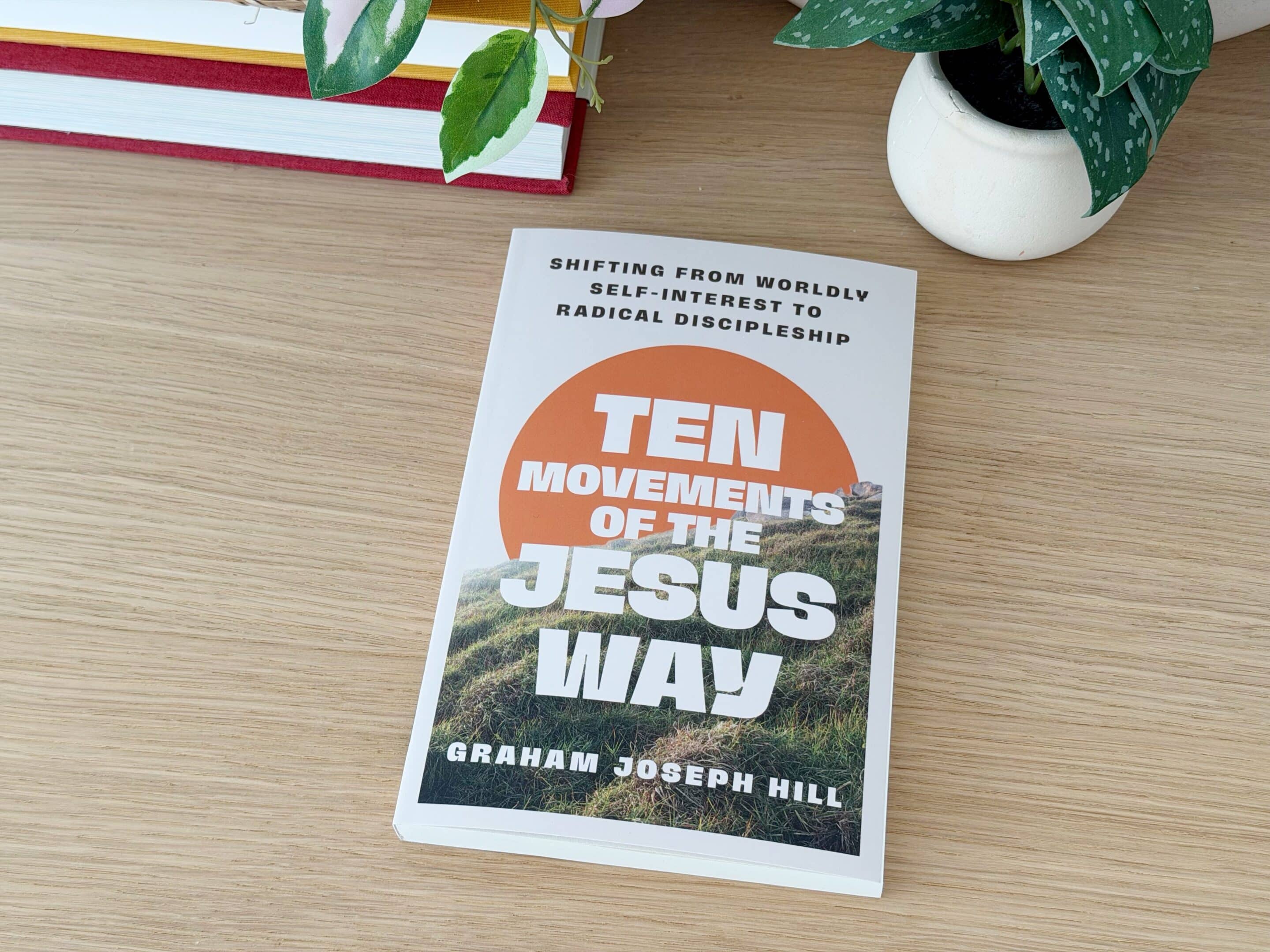
A new book for the journey: releasing July 28If something here has stirred you toward the way of Jesus, you might find a companion in my new book, Ten Movements of the Jesus Way: Shifting from Worldly Self-Interest to Radical Discipleship, releasing with IVP on July 28, 2026. We’re living in a fractured moment, pulled apart by political polarization, performative religion, consumerism, nationalism, and widening inequality. The book offers an alternative: the slow, countercultural, life-giving path of Jesus. Across ten movements, from material success to spiritual riches, from power to servanthood, from exclusion to embrace, it traces a discipleship shaped by humility, justice, generosity, and love. Rooted in Scripture and drawing on the wisdom of African, Asian, Indigenous, and Latin American Christian traditions, it’s a prophetic invitation back to the radical road Jesus walked, and a hopeful vision for a church longing to reflect Christ again. Every chapter closes with questions for reflection, making it a companion for personal devotion, book clubs, and small groups. Preorder your copy now at IVP, Amazon, Barnes & Noble, or Bookshop.org. Also available as an audiobook.
|
____________________________________________________________
Keep walking the Jesus Way: the podcastIf you’d like to go deeper, join me on The Graham Joseph Hill Podcast, where I explore the questions that matter most for Christians today through conversations about faith, justice, spirituality, theology, culture, and the global church. New episodes drop weekly. Listen and subscribe at – https://ghill8.podbean.com
|