The Jesus Way · Movement 1 · From Material Success to Spiritual Riches
The Obituary Test
Here’s an exercise that will ruin your afternoon in the best possible way.
Write your own obituary. Not the one you’d want published, the polished version with the impressive career arc and the list of accomplishments and the line about how you “loved life.” Write the honest one. The one that describes what you actually spent your days doing. The one that names what you gave your energy to, week after week, year after year, when no one was keeping score.
What would it say?
For many of us, the honest obituary would read something like this: She worked hard. She accumulated things. She worried about the things she’d accumulated. She upgraded when she could. She planned carefully for a future that was never guaranteed. She meant to be more generous, but there was always a reason to wait. She died with a full garage, a carefully managed portfolio, and a long list of things she’d been meaning to get around to.
It’s not a cruel obituary. It’s not even an unusual one. It’s the story of a perfectly normal life in a culture that treats accumulation as the highest form of wisdom. And it’s the story Jesus tells in one of his sharpest, most unsettling parables.
The Question That Started It All
The parable begins with an interruption. Jesus is teaching a large crowd when someone calls out from the back: “Teacher, tell my brother to divide the family inheritance with me.”
It’s a common dispute in the ancient world, as it is today. A father has died. The estate needs to be divided. One brother feels cheated. He’s heard that Jesus is a rabbi of authority, and he wants Jesus to take his side.
Jesus refuses. “Friend, who set me to be a judge or arbitrator over you?” And then he turns to the crowd and says something that must have landed like a stone in still water: “Take care! Be on your guard against all kinds of greed; for one’s life doesn’t consist in the abundance of possessions.”
This is a stunning statement in any culture, especially in first-century Palestine, where material blessings were widely understood as evidence of God’s favor. To say that life doesn’t consist in abundance was to challenge a foundational assumption about how the world works. It’s the equivalent of standing up in a modern Western city and announcing that your net worth has nothing to do with your actual worth. People would nod politely and then go right back to checking their investment apps.
But Jesus doesn’t stop with the warning. He tells a story.
The Man Who Built Bigger Barns
“The land of a rich man produced abundantly. And he thought to himself, ‘What should I do, for I have no place to store my crops?’ Then he said, ‘I’ll do this: I’ll pull down my barns and build larger ones, and there I’ll store all my grain and my goods. And I’ll say to my soul, Soul, you’ve got ample goods laid up for many years; relax, eat, drink, be merry.’ But God said to him, ‘You fool! This very night, your life is being demanded of you. And the things you’ve prepared, whose will they be?’ So it is with those who store up treasures for themselves but aren’t rich toward God.”
It’s a tight, devastating little story. A rich man has a bumper crop. His barns are full. He’s got more than he can hold. And so he does what any sensible person in a market economy would do: he expands his storage capacity. He tears down the old barns and builds bigger ones. He consolidates his gains. He secures his future. And then he leans back and congratulates himself on a life well managed.
And God calls him a fool.
What Makes Him a Fool?
This is worth sitting with, because the man in the parable doesn’t do anything that our culture would consider wrong. He doesn’t steal. He doesn’t exploit anyone (at least not within the story). He doesn’t gamble or squander. He’s prudent. He’s strategic. He’s the kind of person who’d get a glowing profile in a business magazine.
So what makes him a fool?
Three things, I think, and they’re all connected.
First, notice the pronouns. In the original Greek, the man’s interior monologue is saturated with first-person references. My crops. My barns. My grain. My goods. My soul. The word that’s glaringly absent from his vocabulary is “you.” There’s no mention of a neighbor, a community, a worker, a beggar at the gate, or a God to whom any of this abundance might be owed. His entire world has collapsed into a single point: himself.
This is the first mark of the fool in biblical wisdom literature. The fool isn’t stupid. The fool is someone who lives as though God doesn’t exist and other people don’t matter. The fool is the person who builds an entire universe with themselves at the center and then wonders why it feels so small.
Second, the man assumes he has time. “Soul, you’ve got ample goods laid up for many years.” Many years. He’s projecting himself into a long, comfortable future. He’s written a narrative in which the next chapter is leisure and the final chapter is far away. And God interrupts the story. This very night. Not next year. Not after retirement. Tonight. The gap between the man’s plan and God’s timing is the entire width of the parable.
Third, and most importantly, the man confuses storage with security. He believes that if he can just accumulate enough, if he can just build barns big enough, he’ll be safe. He’ll have solved the fundamental problem of human vulnerability. And this is his deepest foolishness. Because no amount of accumulation can protect you from the one thing that’s coming for every single one of us. You can’t build a barn big enough to store up a defense against your own mortality.
Rich Toward God
The parable ends with a phrase that’s easy to read past but deserves our full attention: “So it is with those who store up treasures for themselves but aren’t rich toward God.”
Rich toward God. It’s a strange, beautiful expression. What does it mean?
The Greek phrase is eis theon ploutōn, and it carries the sense of “becoming wealthy in the direction of God.” It’s a directional word. Your wealth, your life, your energy, your treasure is moving toward something. The rich fool’s treasure moved toward himself. To be rich toward God means orienting the flow of your life in a different direction.
But what does that look like in practice? I don’t think Jesus is talking about making donations to the temple (though generosity is part of it). I think he’s describing an entire posture of existence.
To be rich toward God is to live with an awareness that everything you have is received. Your breath. Your heartbeat. Your abilities. Your resources. None of it originates with you. All of it passes through you. You’re a steward, a channel, a conduit. And the moment you start treating the gifts as possessions, the moment you start building barns around them, you’ve cut yourself off from the flow.
To be rich toward God is to hold your life with open hands. It’s to receive with gratitude and release with trust. It’s to let your abundance move through you into the world, toward the hungry, the forgotten, the struggling, the overlooked. It’s to understand that the purpose of a blessing isn’t to be stored but to be shared.
The rich fool’s mistake wasn’t that he had a good harvest. It was that the harvest stopped with him. He was a dead end. The grain came in, and nothing went out. He was a reservoir when he was meant to be a river.
The Theology of Enough
There’s a word buried in the rich fool’s monologue that I think reveals the heart of the problem. He says, “Soul, you’ve got ample goods laid up for many years.”
Ample. Enough. More than enough.
He has enough. He knows he has enough. He says he has enough. And then he tears down his barns and builds bigger ones anyway.
This is the logic of accumulation. It can’t recognize enough. The word doesn’t compute. There’s always a reason to expand, to upgrade, to add one more layer of insulation between yourself and the possibility of want. The goalpost is always moving. The barn is never big enough. And the soul’s hunger, which is the real hunger underneath all this activity, goes permanently unfed, because the soul doesn’t eat grain. The soul eats meaning. It eats relationship. It eats love given away.
We live in an economy that depends on our inability to say “enough.” If everyone woke up tomorrow and decided they had had enough, the stock market would collapse by noon. Advertising exists to make sure that moment never arrives. Every commercial is a whisper: You don’t have enough. You aren’t enough. Buy this, and you’ll be closer. And we believe it, over and over, because the whisper is speaking to a real ache inside us. We genuinely do lack something. We’re just looking for it in the wrong barns.
Generosity is the practice that breaks the spell. When you give something away, something that costs you, something you could have kept, you’re doing something subversive. You’re declaring, with your actions, that you have enough. You’re announcing that the logic of accumulation doesn’t own you. You’re stepping out of the story that says your life consists of what you possess and stepping into the story that says your life consists of what you release.
Every act of genuine generosity is a small resurrection. It’s a moment when something that was hoarded comes back to life by being given away. And it’s a glimpse of the economy of God, in which nothing is lost and everything that’s released returns in a form you didn’t expect.
Our Bigger Barns
I want to get specific here, because it’s easy to read a parable like this and nod along without letting it land.
We’re all building bigger barns. The forms vary, but the pattern is remarkably consistent.
There’s the literal version: the house that’s bigger than what you need, filled with things you rarely use, maintained at a cost that keeps you chained to a job you’d have left years ago if you could afford to. There’s the storage unit on the edge of town, holding furniture from a previous life that you can’t bring yourself to part with. There’s the closet full of clothes, most of which you haven’t worn in a year, that represents a version of yourself you’re still hoping to become.
But there are subtler barns too. The savings account you won’t touch because the number has become a source of identity. The knowledge you hoard because sharing it might diminish your expertise. The time you guard so fiercely that there’s never room for an unexpected conversation, an unplanned act of kindness, a detour into someone else’s need.
I’m writing this to myself as much as to you. I know the feeling of looking at what I’ve built, what I’ve stored up, what I’ve carefully arranged, and thinking: If I just had a little more, I’d feel secure enough to be generous. If I just got to the next milestone, I’d start giving more freely. If I just finished this one project, I’d have time for other people.
That’s the rich fool’s monologue in modern dress. And the punchline is always the same: this very night. You don’t have as much time as you think you do. None of us does. The future you’re saving your generosity for may never arrive.
The Interrupted Life
There’s a feature of this parable that I find both terrifying and oddly freeing: the interruption.
The rich fool has a plan. It’s a good plan, by the world’s standards. He’s going to build, store, and enjoy. Three steps. A clean narrative. And God breaks into the middle of it and says: No. That’s not how this goes.
We don’t like interruptions. We build our lives around the assumption of continuity, the belief that tomorrow will be an extension of today, that the trajectory we’re on will continue. And most of the time, it does. But every life, without exception, contains interruptions that shatter the plan. A diagnosis. A layoff. A loss. A phone call in the middle of the night. A global pandemic that rearranges everything.
The question the parable asks isn’t whether the interruption will come. It will. The question is: when it comes, what will you have built? What will remain? If everything you’ve stored up is for yourself, the interruption will reveal the emptiness of the project. But if what you’ve built is a life of love and generosity and faithfulness, a life that’s been pouring itself out in the direction of God and neighbor, then the interruption, as devastating as it may be, won’t find an empty barn. It’ll find a life that was already rich.
This is the freedom hidden in the parable’s severity. If you know that this very night could be the night, then you’re free. You’re free to stop hoarding. You’re free to stop postponing generosity. You’re free to stop living as though you have infinite time to become the person you want to be. You can start now. Today. This hour.
Generosity That Costs Something
In the third post in this series, we explored the lilies and the practice of trust. Here I want to take that a step further. Trust says, “God will provide.” Generosity says, “And I’ll prove I believe it.”
There’s a difference between convenient generosity and costly generosity, and the difference matters.
Convenient generosity is giving from your surplus. It’s dropping spare change into the collection plate, donating clothes you were going to throw away, and tipping well when you’ve had a good month. There’s nothing wrong with it. It’s a starting point. But it doesn’t transform you, because it doesn’t cost you anything. You don’t feel the absence of what you gave.
Costly generosity is different. It’s giving something you’ll miss. It’s writing a check that changes your monthly budget. It’s giving your Saturday to someone who needs help moving, even though you’d planned to rest. It’s sharing a skill, a connection, or an opportunity that you could have kept for yourself. It’s the kind of giving that leaves a gap, and then trusting God to fill it.
This is the kind of generosity that dismantles the barn. Each act of costly giving is a brick removed from the structure of self-reliance, a small declaration that your life doesn’t consist in what you hold but in what you release.
The early church understood this instinctively. In Acts, Luke describes a community that sold possessions and distributed the proceeds to anyone in need. They held everything in common. And the result wasn’t deprivation. The result was that “there wasn’t a needy person among them.” The barns came down. And everyone was fed.
The Shape of Movement 1
This is the final post in Movement 1 of The Jesus Way (From Material Success to Spiritual Riches), and I want to step back for a moment and notice the arc we’ve traveled.
We began with treasure: where it is, where our hearts follow it. We moved to the rich young ruler, and the one thing we can’t imagine releasing. We sat with the lilies and the God who provides in ways we don’t orchestrate. And now, with the rich fool, we’re standing in front of a life that accumulated everything and missed everything.
The movement is from material success to spiritual riches. And the path runs through a series of honest questions: What am I building my life around? What can’t I let go of? Do I trust that I’m held? And finally, today: Am I rich toward God, or am I just rich?
These aren’t questions you answer once. They’re questions you live inside. They’re the kind of questions that surface differently depending on the season you’re in, the pressures you’re facing, the age you’ve reached. What makes someone a fool at thirty may be different from what makes them a fool at sixty. But the pattern is the same. The barn is always the thing that promises security and delivers isolation.
Next week, we begin Movement 2: From Competition to Compassion. We’ll start with the disciples arguing about who among them is the greatest, and we’ll explore the child Jesus placed in their midst. It’s a different kind of foolishness we’ll be looking at, the foolishness of rivalry, and a different kind of richness we’ll be invited into.
A Practice for the Week
This week’s practice is direct. There’s no journaling, no meditation, no reflection exercise (though those are all good). This week, I’m inviting you to do something.
Give something away that costs you something.
It might be money. Give an amount to a person or organization that makes you feel the absence. If your typical gift is comfortable, increase it until it’s uncomfortable. Give enough that you notice it in your budget this month.
It might be time. Offer an afternoon or an evening to someone who needs it. Visit a friend who’s been isolated. Help a neighbor with a project. Volunteer somewhere. Give hours you’d planned to spend on yourself.
It might be something you own. A piece of furniture. A tool. A book you love (not one you were going to discard anyway). Something with weight, something whose absence you’ll feel, something that will leave a gap on the shelf that reminds you of what you chose.
And as you give, pay attention. Notice what happens in your body. Notice the resistance, the tightening, the inner voice that says you might need that, you might regret this, you can’t afford it. And then notice what happens after. The lightness. The strange joy. The sense that something has been loosened inside you, something that was holding you tighter than you realized.
This is what it feels like to take a brick out of the barn. This is what it feels like to become, even a little, rich toward God.
A Question for Reflection
Here’s the question to sit with this week:
If God said to you tonight, “Your life is being demanded of you,” would you be satisfied with what you’ve built? And if not, what would you want to change, starting tomorrow?
I’d love to hear your response. What stirred in you as you read this? Where did you recognize the rich fool in your own life? And if you take on this week’s practice, what did you give, and what did it feel like?
Share your reflections in the comments or pass this along to someone you know who might be ready to hear it.
Grace and peace to you on the journey.
About This Series
This post is part of The Jesus Way, a weekly blog series exploring the ten movements that shape a life of following Jesus. Each movement traces a path the Gospels invite us to walk: from the patterns the world rewards toward the life Jesus actually lived and taught.
Movement 1, From Material Success to Spiritual Riches, asks what happens when we loosen our grip on wealth, status, and accumulation and discover the abundance God has been offering all along.
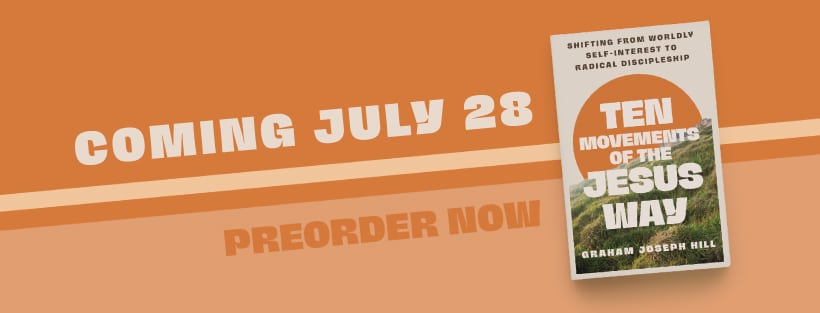
The series builds toward the release of my book, The Ten Movements of the Jesus Way, coming from InterVarsity Press on 28 July 2026. If you’d like to follow the full journey, you can subscribe to receive each new post as it’s published.
Preorder “The Ten Movements of the Jesus Way” here: https://a.co/d/004aPGwi
New Book
Graham Joseph Hill. Ten Movements of the Jesus Way: Shifting from Worldly Self-Interest to Radical Discipleship. InterVarsity Press, July 2026. Preorder here: https://www.ivpress.com/ten-movements-of-the-jesus-way