Few words in Australian public life carry as many layers as the word “fair.” It sits at the heart of our national anthem, Advance Australia Fair, and echoes through our most cherished cultural expression, the “fair go.” In recent years, a lively debate has emerged about what Peter Dodds McCormick meant when he placed “fair” at the close of his 1878 patriotic song. Some scholars argue the word carries racial connotations tied to whiteness. Others contend it’s a straightforward poetic convention meaning beautiful or just. The truth, as with most things worth examining, is more textured than either camp usually allows. And the answer we give shapes how we hear the anthem today, and what we believe it asks of us.
McCormick, a Scottish-born schoolteacher who emigrated to Sydney in 1855, composed the song after attending a concert at the Exhibition Building where various national anthems were performed.[i] He was frustrated that Australia had no anthem of its own and drafted the first verse on the bus ride home. In a letter to R. B. Fuller dated 1 August 1913, he described that moment of inspiration but said nothing about the meaning of “fair.”[ii] He left no diary entry, no marginal note, no published reflection explaining his choice of words. The Sydney Morning Herald, reviewing the song’s debut at the Highland Society on 30 November 1878, described the music as “bold and stirring” and the words as “decidedly patriotic,” predicting it would “become a popular favourite.”[iii] No reviewer mentioned racial overtones. So, we’re left to interpret across a gap of almost 150 years.
The most conventional reading draws on 19th-century British literary tradition. In the poetry and patriotic songs of that era, calling a country “fair” was standard language for beautiful or lovely. “Fair England,” “Fair Caledonia,” and dozens of similar constructions populated the verse McCormick grew up with in Scotland and carried with him to the colonies. Grammatically, Advance Australia Fair reads most naturally as an exhortation to advance beautiful Australia, or to let fair Australia move forward. The word functions as an adjective describing the land, consistent with the song’s celebration of “golden soil,” “nature’s gifts,” and a home “girt by sea.” McCormick wrote roughly thirty patriotic and Scottish ballad-type songs during his lifetime, and his surviving work is steeped in this tradition of poetic praise for land and nation.[iv] The original sheet music was dedicated “Respectfully to the Sons and Daughters of Australia,” and framed as a song of national pride.[v]
The academic challenge to this reading comes principally from Christopher Kelen, a writer and literary scholar whose paper “How Fair is Fair: The Colour of Justice in Australia’s Official Anthem,” published in the M/C Journal, offers the most sustained analysis of the word’s ambiguity.[vi] Kelen argues that three dictionary meanings of “fair” coalesce in the anthem’s usage: fair as beautiful, fair as just, and fair as white. He contends these meanings reinforced one another in 1870s colonial Australia, where the vision of a beautiful, just society was inseparable from assumptions about white British settlement. For Kelen, the song narrates the progress of civilisation across the continent, with the word “advance” carrying overtones of a military movement and the word “fair” describing the kind of polity being built: one that was white by design. He writes that the advance of “fair Australia” constitutes the European transformation of the continent, and that Aboriginal people are given no role in the song precisely because it describes a process that occurs at their expense.[vii]
It’s worth noting what Kelen’s argument does and doesn’t claim. He doesn’t assert that McCormick sat down with a deliberate intention to encode racial meaning into the word. His argument is cultural and structural: that the word operated within a society where whiteness, beauty, and justice were deeply entangled, and that the song’s broader content (its celebration of British settlement, its silence about Indigenous peoples, its original verses about Captain Cook and repelling “foreign invaders”) makes a purely innocent reading difficult to sustain. The ambiguity, for Kelen, is the point. The song doesn’t need to say “white” when every listener in 1878 already inhabited that assumption.[viii]
Other commentators have pointed to the broader political context. Australia’s first piece of federal legislation after Federation in 1901 was the Immigration Restriction Act, the legislative foundation of what became known as the White Australia Policy. A separate composition from the early 1900s, the “White Australia March,” used strikingly similar patriotic language, including the line “Australia, the white man’s land.”[ix] The Sovereign Union website has argued that the key words “Advance Australia” and “Fair” appear to have been drawn from the same ideological songbook.[x] Meanwhile, the SBS NITV journalist who compiled “10 Things You Should Know About Advance Australia Fair” observed that in a country which enshrined racial exclusion as its founding legislative act, the question about what “fair” meant was “probably not an unreasonable question to ask.”[xi] This contextual argument has genuine force. The song existed within, and was shaped by, a culture of white supremacy, even if its author may have intended nothing more than a compliment to the landscape.
Yet the absence of direct evidence matters. No contemporary review from 1878 interprets “fair” as referring to skin colour. No correspondence from McCormick hints at it. The White Australia March appeared more than two decades after the anthem was composed, so claims of direct influence run in the wrong chronological direction. The EBSCO Research summary of the anthem captures the interpretive balance well, noting that “fair” in the title can be read as meaning beautiful, but that many Australians also see it as referring to fair skin or white people.[xii] Both readings coexist, and honest engagement with the anthem requires sitting with that tension.
This is the ground on which I chose the title Advance Australia Fairer for my book about justice, belonging, and the common good.[xiii] I chose it because it names the heart of our national challenge. The anthem’s words capture an aspiration for equality, fairness, and progress. They point toward something Australians have always longed for: a society where the “fair go” is real, where dignity belongs to everyone, where the land itself is honoured. That aspiration is worth claiming, even as we acknowledge the enormous gap between promise and reality.
To say “Advance Australia Fairer” is to take the most generous reading of “fair” and push it further. It’s to say: if our anthem calls us toward fairness, then let’s get there. Let’s close the gap between the song we sing and the society we’ve built. Fairness remains incomplete while more than 3.7 million Australians live in poverty, while First Nations peoples wait for justice, treaty, and truth, while housing and health remain unequal, while migrants struggle for security, and while ecological breakdown threatens our common future.[xiv] The comparative “fairer” insists that equity, truth, and sustainability must become central to our shared horizon.
Any honest use of the word “fairer” must begin with the people who’ve called this continent home for more than sixty thousand years. First Nations Australians carry the longest continuous cultures on earth, and their story is inseparable from the story of this land. To advance Australia fairer while sidestepping that truth would be to repeat the very silence the anthem has always been criticised for.
The history is well documented and demands acknowledgment. Colonisation brought dispossession, frontier violence, forced removal of children, destruction of languages, and systematic exclusion from the civic life of a nation built on Aboriginal land. The White Australia Policy, the very legislation some scholars link to the anthem’s context, was part of a broader architecture of racial exclusion that shaped law, culture, and daily life for generations. These wounds haven’t healed because they haven’t been fully faced. The Stolen Generations are within living memory. Incarceration rates for Indigenous Australians remain among the highest in the world. Life expectancy gaps persist. Housing, health, and educational disadvantage continue to mark the daily experience of too many First Nations communities.
Acknowledging this history is essential, but “fairer” asks for something deeper than acknowledgment. It asks for a posture of listening and learning. First Nations peoples hold knowledge systems of extraordinary sophistication: ecological intelligence refined over millennia, kinship structures that sustain community across vast distances, practices of land management that scientists now recognise as essential for climate adaptation. Aboriginal and Torres Strait Islander leaders, elders, and communities have been offering this wisdom to the nation for decades. The question has always been whether the rest of Australia is willing to receive it.
Listening to First Nations voices means centring Indigenous leadership in the decisions that affect Indigenous lives. It means supporting truth-telling processes like the Yoorrook Justice Commission in Victoria, where survivors and communities speak their experiences into the public record. It means honouring the Uluru Statement from the Heart as an invitation extended with extraordinary generosity: a hand outstretched by the people who’ve borne the deepest costs of our national story. It means walking alongside communities like the Aboriginal Carbon Foundation, where ancient fire practices and modern carbon science combine to heal Country and create economic opportunity on Aboriginal terms.
A fairer Australia is one where reconciliation is lived in local councils, classrooms, and workplaces, where the oldest cultures on this continent are treated as a source of national strength and public wisdom. The path forward requires patience, humility, and the courage to sit with uncomfortable truths. It requires settlers and newcomers alike to understand that the land we share holds stories far older than our own, and that those stories contain lessons we urgently need.
To advance Australia fairer is, first and fundamentally, to listen to the people whose sovereignty was never ceded and whose wisdom has sustained this land since long before any anthem was written.
I’m not interested in anchoring my title in the negative connotations of “fair.” The racial reading has scholarly legitimacy as cultural analysis, and it names something real about the era in which the song was written. But the word ‘fair’ also carries an aspiration that’s deeply good: beauty, justice, equity, the dream of a decent society where everyone has enough to live on, meaningful work, and a place to belong. That’s the thread I want to pull, while recognising our history of racism in this country and utterly rejecting and condemning any racist attitudes toward First Nations peoples and anyone else. The title Advance Australia Fairer is an act of reclamation. It says: this word belongs to all of us now. Whatever “fair” once meant in the mouths of colonists who excluded First Nations peoples from the national imagination, the call to fairness can become something larger, something more honest, something more generous.
To advance Australia fairer is to insist that the good life grows from shared tables, honest reckoning, and the slow work of learning to see strangers as neighbours. It’s carried together by communities secular and sacred alike. It’s a vision for Australians of every belief and no belief, Indigenous and migrant, young and old. It holds that fairness must be lived in housing policy and health funding, in truth-telling and ecological care, in the way we welcome newcomers and honour the oldest living cultures on earth.
The debate about what “fair” originally meant will continue, and it should. Honest societies examine their symbols. But alongside that examination, we can choose to fill the word with the meaning it deserves: a commitment to justice, belonging, and the common good that includes every person who calls this land home. That’s the Australia I want to help build. That’s what “fairer” means. And it begins now, with us, together.
_____________________________________________
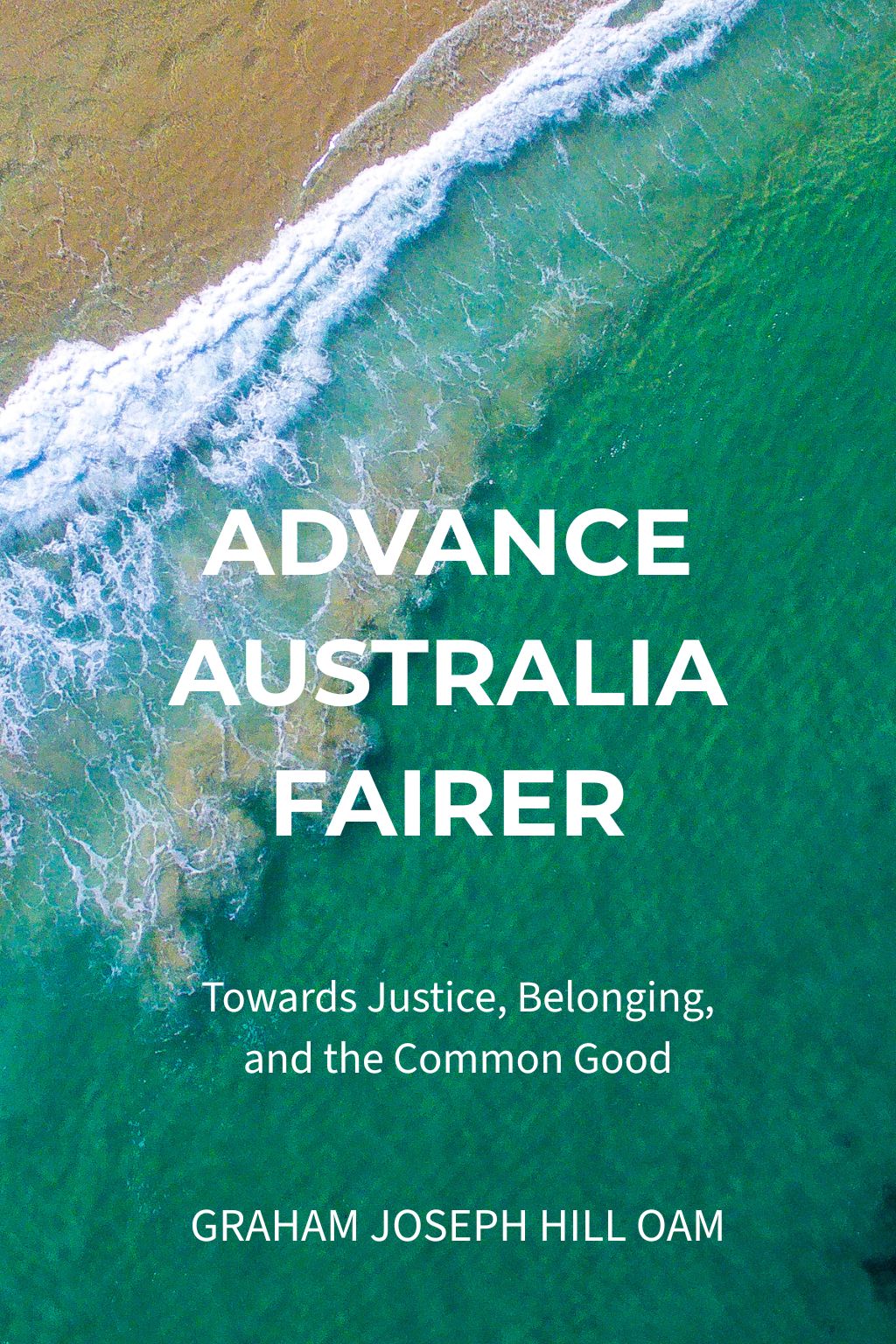
Advance Australia Fairer: Towards Justice, Belonging, and the Common Good is available now.
Amazon Australia link: https://amzn.asia/d/09o9VcIA
Amazon US link: https://a.co/d/0hPZkf59
_____________________________________________
Bibliography
Australian Council of Social Service and University of New South Wales. Poverty in Australia 2023: Who Is Affected. Sydney: ACOSS/UNSW Poverty and Inequality Partnership, 2023. https://unsworks.unsw.edu.au/entities/publication/8de4ffb8-c77c-4ed3-b89f-2f177b7ca790.
Fletcher, Jim. “McCormick, Peter Dodds (1833–1916).” Australian Dictionary of Biography, Volume 10. Melbourne: Melbourne University Press, 1986. Accessed March 2026. https://adb.anu.edu.au/biography/mccormick-peter-dodds-7323.
Hill, Graham Joseph. Advance Australia Fairer: Towards Justice, Belonging, and the Common Good. Sydney: Eagna Publishing, 2026.
Kelen, Christopher. “How Fair is Fair? The Colour of Justice in Australia’s Official Anthem.” M/C Journal 5, no. 3 (July 2002). https://journal.media-culture.org.au/index.php/mcjournal/article/view/1964.
McCormick, Peter Dodds. Letter to R. B. Fuller, 1 August 1913. Quoted in “Advance Australia Fair.” Wikipedia. Last modified March 2026. https://en.wikipedia.org/wiki/Advance_Australia_Fair.
Sovereign Union: First Nations Asserting Sovereignty. “‘Advance Australia Fair’ and ‘The White Australia Policy.’” Accessed March 2026. https://nationalunitygovernment.org/content/was-advance-australia-fair-written-white-people.
“10 Things You Should Know About Advance Australia Fair.” SBS NITV, 31 January 2017. https://www.sbs.com.au/nitv/article/10-things-you-should-know-about-advance-australia-fair/x0tp1zwbs.
Ungvarsky, Janine. “Advance Australia Fair.” In EBSCO Research Starters: Music. Ipswich, MA: EBSCO, 2019. Accessed March 2026. https://www.ebsco.com/research-starters/music/advance-australia-fair.
“Advance Australia Fair.” Songfacts. Accessed March 2026. https://www.songfacts.com/facts/andrew-fairfax/advance-australia-fair.
Footnotes
[i] Fletcher, “McCormick, Peter Dodds (1834–1916),” Australian Dictionary of Biography, vol. 5.
[ii] McCormick, letter to Fuller, 1 August 1913, quoted in “Advance Australia Fair.”
[iii] Fletcher, “McCormick, Peter Dodds.” See also “Advance Australia Fair,” Songfacts.
[iv] Ungvarsky, “Advance Australia Fair,” in EBSCO Research Starters: Music.
[v] “Advance Australia Fair,” Songfacts.
[vi] Kelen, “How Fair is Fair? The Colour of Justice in Australia’s Official Anthem.”
[vii] Kelen, “How Fair is Fair?”
[viii] Kelen, “How Fair is Fair?”
[ix] “‘Advance Australia Fair’ and ‘The White Australia Policy,’” Sovereign Union: First Nations Asserting Sovereignty.
[x] “‘Advance Australia Fair’ and ‘The White Australia Policy.’”
[xi] “10 Things You Should Know About Advance Australia Fair,” SBS NITV.
[xii] Ungvarsky, “Advance Australia Fair.”
[xiii] Hill, Advance Australia Fairer.
[xiv] Australian Council of Social Service and University of New South Wales, Poverty in Australia 2023: Who Is Affected.