The Jesus Way · Movement 2 · From Competition to Compassion
The Art of Looking Away
You’ve done it. I’ve done it. We’ve all done it.
Someone is sitting on the pavement outside the train station with a cardboard sign and a paper cup. You see them from twenty meters away. And something happens in your body before your mind forms a conscious thought. Your gaze shifts. Your pace quickens. You reach for your phone. By the time you pass them, you’ve created enough distance, physical and psychological, that the encounter barely registers.
You didn’t decide. The looking-away happened automatically, like a reflex. Your nervous system executed the whole maneuver before your moral imagination had time to engage.
We’ve all developed this skill. We’ve practiced it thousands of times, in cities and suburbs, in hospital corridors and church lobbies, on social media feeds and in our own families. The art of looking away. The quiet, almost effortless act of walking past another person’s pain.
Jesus told a story about this. It’s the most famous parable he ever told. And the reason it’s lasted two thousand years is that it catches us in the act.
The Lawyer’s Question
The story begins with a test. A lawyer, an expert in the Torah, stands up and asks Jesus a question: “Teacher, what must I do to inherit eternal life?”
Luke tells us the man’s motive: he wants to test Jesus. This isn’t a sincere seeker kneeling in the road, like the rich young ruler we met a few weeks ago. This is a professional debater looking for a sparring match. He already knows the answer. He wants to see if Jesus does.
Jesus, characteristically, answers the question with a question: “What’s written in the law? What do you read there?”
The lawyer gives the textbook answer, combining Deuteronomy 6:5 and Leviticus 19:18: “You shall love the Lord your God with all your heart, and with all your soul, and with all your strength, and with all your mind; and your neighbor as yourself.”
“You’ve given the right answer,” Jesus says. “Do this, and you’ll live.”
But the lawyer isn’t finished. He wants to justify himself, Luke tells us. And so, he asks the question that opens the door to the parable: “And who is my neighbor?”
It sounds like a philosophical question. A boundary question. The lawyer wants a definition, a category, a clear set of criteria for who qualifies as a neighbor and, by implication, who doesn’t. He’s looking for the edge of the obligation. He wants to know where love can reasonably stop.
Jesus’s answer will demolish the question entirely.
The Road to Jericho
“A man was going down from Jerusalem to Jericho, and fell into the hands of robbers, who stripped him, beat him, and went away, leaving him half dead.”
The road from Jerusalem to Jericho was seventeen miles of steep descent through rocky, desolate terrain, dropping over a thousand meters in elevation. It was notoriously dangerous, winding through narrow ravines where bandits could ambush travelers with ease. Everyone in Jesus’s audience would’ve known this road. The setting is immediate and vivid. This could happen to anyone.
The man lies in the road. He’s been stripped, so there’s no way to identify his social class or ethnicity from his clothing. He’s been beaten, so his face may be unrecognizable. He’s half dead, so he may not be able to speak. He’s been reduced to the most basic human condition: a body in pain, needing help.
And now, one by one, three travelers come down the road.
The Two Who Passed By
“Now by chance a priest was going down that road; and when he saw him, he passed by on the other side. So likewise, a Levite, when he came to the place and saw him, passed by on the other side.”
We tend to read the priest and the Levite as villains. Heartless religious hypocrites who couldn’t be bothered. But I think Jesus is doing something more nuanced and more devastating than painting cartoon villains. I think he’s describing people who had reasons.
The priest was likely travelling from Jerusalem, where he’d been serving in the temple, back to his home in Jericho. If he touched a dead body or even came close enough to check whether the man was dead, he’d become ritually unclean. He’d be disqualified from his priestly duties. His responsibilities, his role in the community, would be disrupted.
The Levite faced similar concerns. And beyond the purity laws, there were practical calculations. The road was dangerous. The robbers might still be nearby. The man might already be dead, in which case touching him would accomplish nothing except contamination.
These are rational considerations. They’re the kind of thinking that makes perfect sense from the inside. And that’s what makes them so dangerous.
Because the priest and the Levite didn’t do something monstrous. They did something ordinary. They assessed the situation, weighed the costs, considered the risks, and made a practical decision. They chose their obligations over someone’s suffering. They chose institutional duty over immediate mercy. They chose the system over the person.
And then they crossed to the other side of the road. That detail is precise and terrible. They didn’t just fail to stop. They actively created distance. They moved their bodies away from the wounded man. They made the looking-away physical.
This is what avoidance looks like when it’s dressed in good reasons. It’s the church that locks its doors during the week because of liability concerns. It’s the individual who drives a different route so they don’t have to pass the homeless encampment and feel the tug. In every case, the reasons are understandable. In every case, someone is left lying in the road.
The One Who Stopped
“But a Samaritan while travelling came near him; and when he saw him, he was moved with compassion.”
To feel the shock of this, you need to understand what a Samaritan meant to Jesus’s audience.
The hatred between Jews and Samaritans was centuries old, rooted in disputes over worship, territory, and theological legitimacy. Samaritans were considered heretical, ethnically impure, and religiously compromised. The two communities avoided each other. They worshipped in different places. They told different stories about who they were. The boundary between Jew and Samaritan was one of the thickest walls in the ancient world.
And Jesus makes the Samaritan the hero.
This would’ve been offensive to many in his audience. The lawyer who asked the original question was almost certainly Jewish. The crowd listening was almost certainly Jewish. And Jesus is telling them that the person who understood love of neighbor, the person who embodied the Torah’s deepest command, was the outsider. The heretic. The enemy.
The Samaritan sees the man in the road and is “moved with compassion.” The Greek word is splanchnistheis, from splanchna, which refers to the bowels, the guts, the deep interior of the body. It’s the same word used to describe Jesus’s own response to suffering throughout the Gospels. This is visceral compassion. It’s a physical response, something that happens in the body before the mind has time to construct reasons for avoidance.
And then the Samaritan acts. The details Luke provides are remarkable in their specificity: he goes to the man, bandages his wounds, pours oil and wine on them (the standard first-century medical treatment), sets him on his own animal, brings him to an inn, takes care of him through the night, and the next day pays the innkeeper with two denarii (about two days’ wages), promising to return and cover any additional costs.
Every detail matters. He uses his own transport, which means he’s now walking. He spends his own time. He makes himself personally responsible for a stranger’s recovery. He puts his own body, his schedule, his money, and his plans at the service of someone who, by every cultural standard, would’ve been his enemy.
Compassion, in this story, is a full-body commitment. It’s concrete, costly, and ongoing. It disrupts the Samaritan’s journey. It rearranges his day. It empties his wallet. And he does it for a man who, if the roles were reversed, might well have crossed to the other side.
The Question Reversed
When the parable ends, Jesus asks the lawyer a question: “Which of these three, do you think, was a neighbor to the man who fell into the hands of the robbers?”
Notice what’s happened. The lawyer asked, “Who is my neighbor?” He wanted to know who qualifies for his love. He wanted a boundary. Jesus has answered by flipping the question completely. He’s asking: Who became a neighbor? Who acted like one?
The lawyer’s question was about categorization: which people fall within the circle of my obligation? Jesus’s counter-question is about action: which person entered the circle of another’s need? The lawyer wanted a map with clear borders. Jesus gave him a story about someone who ignored every border and followed the pull of compassion into the life of a stranger.
The lawyer answers correctly: “The one who showed him mercy.” (Luke notes that he can’t bring himself to say the word “Samaritan.” Even in conceding the point, the boundary holds.)
“Go and do likewise,” Jesus says.
Four words. An entire ethic. The entire Jesus Way compressed into a single instruction: when you see someone suffering, stop. Cross the road toward them. Let compassion override every reason you have for walking past.
The Boundaries We Build
Every culture builds walls between people. We sort one another into categories and then use those categories to determine who deserves our attention. In Jesus’s day, the categories were religious purity, ethnic identity, and social class. In our own, they’re political affiliation, economic bracket, race, nationality, and the invisible algorithms that curate our social feeds so efficiently that we can go weeks without encountering a different perspective.
We all have a version of the Jew-Samaritan divide. We all have people we’ve placed on the other side of a boundary so thick that their suffering registers as abstract, as distant, as someone else’s problem.
It might be a political boundary. The people on the other side of the aisle, the ones whose views make your blood pressure rise, are easy to dehumanize. Their pain is harder to feel when you’ve already filed them under “enemy.”
It might be a geographic boundary. The crisis on the other side of the world feels less real than the inconvenience in your own suburb. The suffering of people in a country you’ve never visited is easy to absorb as a statistic and forget by dinnertime.
It might be a social boundary. In every workplace, every school, every church, there are people who are invisible. They’re present, they contribute, they show up, but they occupy a social position that makes them easy to overlook. They’re the ones who eat lunch alone. The ones whose names people forget. The ones who leave a room and nobody notices.
These are the roads we walk every day. And on each of them, someone is lying in the ditch.
The Good Reasons for Walking Past
I want to linger on the priest and the Levite, because I think they’re the key to the parable’s contemporary power.
We’re quick to identify with the Samaritan. We like to think we’d stop. We imagine ourselves as the compassionate one, the one who crosses the road. But the parable is structured so that most of us, if we’re honest, live much closer to the priest and the Levite. We’re the ones with good reasons.
I’m too busy. This is the most common reason, and the most corrosive. Busyness has become a form of moral armor in modern life. If your schedule is full, you’re exempt from the demands of the road. The wounded man is someone else’s responsibility. You have a meeting.
I’m not qualified. The suffering is too big, too complex, too entrenched. What could I possibly do? This reasoning sounds humble. Underneath it is a refusal to do the small, imperfect thing that’s right in front of you.
It’s not safe. The neighborhood is unfamiliar. The person is unpredictable. There might be consequences. Again, these concerns are real. The Samaritan took a risk. Compassion always involves risk. The question is whether the risk of stopping is greater than the cost of walking by.
Someone else will help. This is the bystander effect dressed in everyday clothes. Surely someone more capable will come along. And sometimes they do. But sometimes the road stays empty, and the man in the ditch waits.
Each of these reasons has a kernel of truth. That’s what makes them so effective. The priest and the Levite were protected by the plausibility of their excuses. And so are we.
Compassion That Crosses
The Samaritan’s compassion is remarkable for what it costs him and for what it crosses.
It crosses the ethnic divide. The Samaritan helps a man who, in all likelihood, belongs to the community that despises him. He doesn’t check the man’s credentials before kneeling. He doesn’t ask whether the man deserves his help, or whether the man would help him if the situation were reversed. Compassion, as Jesus describes it, is indifferent to categories. It responds to the wound, period.
It crosses the comfort divide. The Samaritan could’ve dropped a few coins and kept walking. Instead, he gets off his animal. He touches the wounds. He pours his own oil and wine. He lifts the man onto his donkey. Compassion enters the mess.
It crosses the time divide. The Samaritan doesn’t help for five minutes and move on. He stays the night. He makes arrangements for ongoing care. He promises to return. His compassion has a future tense. It’s a commitment, an investment of hours and days, a willingness to let someone else’s crisis reshape his calendar.
And it crosses the financial divide. Two denarii was significant money for a travelling Samaritan. And he offers an open-ended guarantee: “Whatever more you spend, I’ll repay you.” He’s writing a blank cheque against his own resources. Compassion, in this story, reaches into the wallet.
This is what love of neighbor looks like when it gets specific. It’s physical. It’s expensive. It takes time. It disrupts plans. It bridges every boundary that the world has constructed to keep us from one another. And it begins with a single moment: seeing someone in pain and allowing that sight to reach your gut.
Who Do You Pass By?
I’ve been sitting with this parable for weeks, and the question it keeps pressing into me is personal and specific: Who do I pass by?
I have my version of the other side of the road. I have the routes I take to avoid discomfort. I have the notifications I dismiss, the conversations I deflect, the faces I’ve trained myself to look past.
There’s the elderly woman in my neighborhood who always wants to talk when I’m in a hurry. There’s the colleague who’s clearly struggling, whose eyes are tired and whose answer is always “fine,” and who I haven’t asked a second question. There’s the friend who keeps texting and whose texts I keep meaning to return but never do, because returning them would mean entering a conversation that requires something of me.
And there are the larger passings-by. The news stories I scroll past because the suffering is happening far away. The systemic injustices I’m vaguely aware of but haven’t allowed to disturb me. The people in my own city who live in conditions I’ve never seen, because I’ve arranged my life so that I don’t have to.
I’m not writing this from a place of mastery. I’m writing from the priest’s side of the road, looking across at a wounded world and recognizing, with a mixture of shame and hope, that I have a choice. I can keep walking. Or I can cross.
The Shape of Compassion
This series is called The Jesus Way, and I want to root the parable back in the person who told it.
Because Jesus, throughout the Gospels, lives the Samaritan’s story. He touches lepers. He eats with tax collectors. He speaks with women in public. He welcomes children. He embraces the people that his society has placed firmly on the other side of every road.
The word splanchnistheis, the gut-level compassion that moved the Samaritan, is used repeatedly to describe Jesus himself. He sees a widow burying her only son, and he’s moved with compassion. He sees a crowd like sheep without a shepherd, and he’s moved with compassion. He sees two blind men on the roadside, and he’s moved with compassion.
Compassion, for Jesus, is the natural response of a heart aligned with God’s heart. God sees suffering and moves toward it. The incarnation itself is the ultimate Good Samaritan story: God finds humanity lying in the road, broken and half dead, and instead of passing by, comes down, kneels in the dirt, and pours out everything.
When Jesus says, “Go and do likewise,” he’s inviting us into the pattern of his own life. Let compassion move you. Let it override your schedule, your budget, your comfort. Let it pull you across the road and into the life of someone you’d normally pass.
A Practice for the Week
This week’s practice is deceptively simple.
Notice one person you would normally overlook. And move toward them.
It might be someone you see every day: the barista who makes your coffee, the cleaner at your office, the neighbor whose name you’ve never learned. It might be someone you encounter once: a person on the street, a struggling parent at the shops, a stranger sitting alone.
Here’s the practice, in three steps:
See them. Let your gaze rest on someone you’d usually glance past. Take in their face, their posture, their expression. Let them become a person to you, with a life as full and complex as your own.
Cross the road. Move toward them in some concrete way. It might be a greeting, a question, an offer of help, a moment of unhurried conversation. The gesture doesn’t need to be grand. It needs to be genuine.
Stay a moment longer than is comfortable. The temptation will be to check the box and move on. Resist that. Let the encounter breathe. Ask a follow-up question. Listen to the answer. Let them feel, even for thirty seconds, that they’ve been truly seen.
At the end of the week, look back. What happened in you when you stopped? What did you find on the other side of the road?
A Question for Reflection
Here’s the question to carry with you:
Who is lying in the road on your daily route, and what would it cost you to stop?
I’d love to hear your answer. Where did this parable catch you? Who came to mind when you thought about the person you normally pass by? And if you practiced crossing the road this week, what happened?
Share your reflections in the comments or send this to someone who might need it. Sometimes the most compassionate thing you can do is remind another person that they’re allowed to stop.
Next week, we continue in Movement 2 with “Jesus Moved with Compassion,” exploring the moments in the Gospels when something broke open in Jesus’s own heart. We’ll ask what moves us and what leaves us unmoved. I hope you’ll join me.
Grace and peace to you on the journey.
New Book
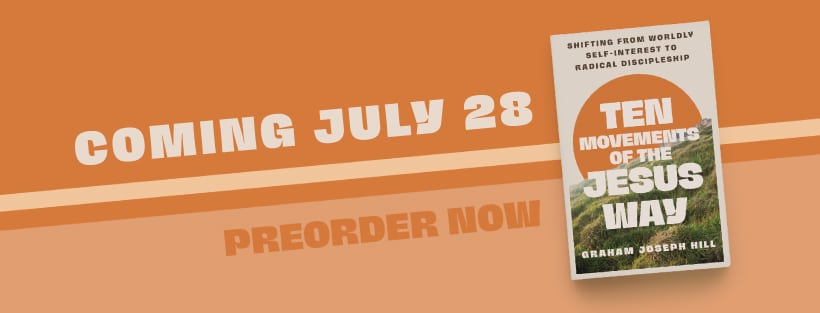
Graham Joseph Hill. Ten Movements of the Jesus Way: Shifting from Worldly Self-Interest to Radical Discipleship. InterVarsity Press, July 2026. Preorder here: https://www.ivpress.com/ten-movements-of-the-jesus-way
About This Series
This post is part of The Jesus Way, a weekly blog series exploring the ten movements that shape a life of following Jesus. Each movement traces a path the Gospels invite us to walk: from the patterns the world rewards toward the life Jesus actually lived and taught.
The series builds toward the release of my book, The Ten Movements of the Jesus Way, coming from InterVarsity Press on 28 July 2026. If you’d like to follow the full journey, you can subscribe to receive each new post as it’s published.
Preorder “The Ten Movements of the Jesus Way” here: https://a.co/d/004aPGwi