The Jesus Way · Movement 2 · From Competition to Compassion
What Still Gets to You?
There’s a question I’ve been asking people lately, in conversations over coffee, in small groups, in the quiet margins after church. It’s a simple question, but it tends to open something up.
What still gets to you?
I mean, what can still reach you? What can still break through the thick glass of routine and responsibility and information overload and get all the way to your gut? What makes you stop scrolling, stop talking, stop performing, and feel something so deep it catches in your throat?
The answers vary. For one friend, it’s the sight of an elderly person eating alone at a restaurant. For another, it’s videos of refugees carrying children across borders. For another, it’s a particular hymn her mother used to sing. For a man in my small group, it’s watching his teenage son struggle with anxiety and knowing he can’t fix it.
And then there’s the harder follow-up question, the one that takes longer to answer: What’s stopped getting to you? What suffering, what need, what face in the crowd used to move you but doesn’t anymore? Where have you gone numb?
These are the questions underneath this week’s text. Because when the Gospels describe Jesus, they describe a man who was extraordinarily, almost alarmingly, movable. The suffering of the world reached him. It got past every defence. It landed in his body. And what it produced there, again and again, was a response so visceral and consistent that the Gospel writers gave it a specific name.
They called it compassion.
The Scene in Matthew 9
Here’s the passage:
“Then Jesus went about all the cities and villages, teaching in their synagogues, and proclaiming the good news of the kingdom, and curing every disease and every sickness. When he saw the crowds, he had compassion for them, because they were harassed and helpless, like sheep without a shepherd. Then he said to his disciples, ‘The harvest is plentiful, but the labourers are few; therefore, ask the Lord of the harvest to send out labourers into his harvest.’”
It’s a summary passage. Matthew is pulling back the camera to show us the pattern of Jesus’s ministry: he travels, he teaches, he heals, he looks at the people around him, and he’s moved. The verse functions almost like a time-lapse, compressing weeks or months of activity into a single frame. And at the centre of that frame, holding the whole thing together, is the moment when Jesus sees and feels.
The Greek word translated as “had compassion” is splanchnizomai. We encountered it in last week’s post about the Good Samaritan. It comes from splanchna, the bowels, the guts, the deep interior cavity of the body. In the ancient world, this was where the strongest emotions were believed to live. Splanchnizomai describes something that seizes you from the inside, a physical response so powerful it demands action. Your stomach turns. Your chest tightens. Your body knows something before your mind catches up.
This is what happens in Jesus when he looks at the crowds. He sees them, and something moves in the deepest part of him.
Harassed and Helpless
Matthew tells us what triggered the compassion: Jesus saw the crowds as “harassed and helpless, like sheep without a shepherd.”
The Greek words are eskulmenoi and errimmenoi. The first carries the sense of being flayed, torn, or mangled. The second means thrown down, cast aside, lying prostrate. Together they paint a picture of people who’ve been chewed up and spat out. These are people who are exhausted, exploited, directionless, and abandoned by the very leaders who should have been caring for them.
The shepherd image is loaded. In the Old Testament, the leaders of Israel, the kings, the priests, the prophets, were called shepherds of God’s people. And the prophets, especially Ezekiel, had harsh words for shepherds who fed themselves instead of the flock, who let the sheep scatter, who grew fat while the animals in their care grew thin and sick. “You have not strengthened the weak, you have not healed the sick, you have not bound up the injured, you have not brought back the strayed, you have not sought the lost,” God says through Ezekiel. “But with force and harshness you have ruled them.”
Jesus looks at the crowds and sees Ezekiel’s prophecy come to life. He sees people who’ve been failed by their leaders, burdened by religious demands, crushed by Roman occupation, and left to fend for themselves. And his gut response is compassion.
This matters because it tells us something essential about how Jesus sees the world. He doesn’t look at a struggling crowd and see a problem to be managed, a demographic to be analysed, or a market to be tapped. He sees people who are hurting, and he feels it in his body.
A Map of What Moved Him
Matthew 9 isn’t the only place the Gospels use this word. Splanchnizomai appears repeatedly, and each time it gives us a window into what stirred the heart of Jesus. Taken together, these passages form a kind of map of his compassion, showing us exactly where his attention went and what broke through.
He was moved by hunger. In Matthew 15:32, Jesus says to his disciples, “I have compassion for the crowd, because they’ve been with me now for three days and have nothing to eat.” This is the feeding of the four thousand. Jesus notices that the people are hungry. He notices it before his disciples do. And his response begins in his gut, in that same deep place, before it becomes a miracle of bread and fish.
He was moved by sickness. In Matthew 14:14, Jesus sees a great crowd, and “he had compassion for them and cured their sick.” In Matthew 20:34, two blind men call out to him from the roadside, and “moved with compassion, Jesus touched their eyes.” Physical suffering reached him immediately. He didn’t flinch from disease or disability. He moved toward it.
He was moved by grief. In Luke 7:11–17, Jesus encounters a funeral procession outside the town of Nain. A widow is burying her only son. Luke tells us: “When the Lord saw her, he had compassion for her and said to her, ‘Don’t weep.’” Then he raises the boy from the dead. But the compassion comes first. Before the miracle, before the intervention, there’s the seeing and the feeling.
He was moved by lostness. In the parables of Luke 15, Jesus tells stories about a lost sheep, a lost coin, and a lost son. In the story of the prodigal, the father sees his son coming home from a long way off and is “filled with compassion.” He runs to meet him. This is Jesus’s portrait of God: a parent whose compassion is so fierce it makes him abandon dignity and sprint down the road.
He was moved by leprosy. In Mark 1:40–41, a leper kneels before Jesus and says, “If you choose, you can make me clean.” Mark tells us Jesus was “moved with compassion” (some manuscripts say, “moved with anger,” which may be even more revealing). He reaches out and touches the man. In a world where lepers were untouchable, Jesus’s hand on the man’s skin was as revolutionary as the healing itself.
What emerges from this survey is a picture of someone whose emotional life was profoundly open to the suffering around him. Hunger moved him. Sickness moved him. Grief moved him. Isolation moved him. Directionless, leaderless crowds moved him. He wasn’t selective about whose pain he felt. He wasn’t strategic about whose suffering he responded to. Wherever there was a wound, his compassion went.
Compassion as a Way of Seeing
I want to notice something about the pattern in all these passages. In every case, the compassion begins with seeing. Jesus saw the crowds. He saw the sick. He saw the widow. He saw the leper. The seeing comes first. The feeling follows. And the action follows the feeling.
This sequence matters because it tells us that compassion is rooted in attention. You can’t be moved by something you haven’t noticed. You can’t feel someone’s pain if you haven’t looked at them long enough to register that they’re in pain. The first act of compassion, every time, is the act of seeing.
And seeing, real seeing, is harder than it sounds.
We live in an age of unprecedented visibility. We have more access to the world’s suffering than any generation in human history. A famine in East Africa, a war in the Middle East, a flood in Southeast Asia: all of it arrives on our screens within minutes, accompanied by images so vivid they should break us open every time.
And yet something strange has happened. The sheer volume of visible suffering has, for many of us, produced a kind of anaesthesia. We see so much that we’ve stopped seeing. The images wash over us. The numbers blur together. The faces become interchangeable. We’ve developed a protective glaze, an emotional screensaver that keeps us functioning in a world that would otherwise overwhelm us.
This is understandable. It may even be necessary, in small doses, as a form of psychological self-preservation. But it comes at a cost. The cost is that we can look directly at suffering and feel nothing. We can scroll past a dying child and keep eating our lunch. We can walk past a person sleeping on the pavement and register them as part of the scenery.
Jesus, as far as we can tell, had no such protective glaze. The suffering reached him, every time, at full force. And it moved him, every time, from his gut to his hands.
What Leaves Us Unmoved
I want to get honest here, because I think this is where the passage becomes most uncomfortable.
Most of us have a compassion map with significant blank spots. There are kinds of suffering that move us, and kinds that leave us cold. And the pattern of our compassion, where it flows and where it stops, reveals something important about the shape of our hearts.
We tend to feel compassion for people who are like us. The family that looks like ours, the child who could be ours, the illness we could imagine having. Similarity is a powerful catalyst for empathy. When we can see ourselves in someone’s story, the compassion comes easily.
We tend to feel less when the suffering is distant, whether geographically, culturally, or socially. The earthquake on the other side of the world produces a brief pang and then we move on. The refugee crisis generates concern for a news cycle and then fades. The homeless man on the corner has been there so long he’s become invisible.
And we tend to feel the least compassion for people whose suffering we’ve decided they brought on themselves. The addict. The prisoner. The person who made “bad choices.” The single parent. The unemployed worker. Once we’ve filed someone’s suffering under “their own fault,” our compassion switch turns off. We’ve constructed a reason for withholding it, and the reason feels righteous.
Jesus’s compassion map had no blank spots. He felt for the crowds, who were victims of systemic failure. He felt for the leper, who was a victim of disease. He felt for the prodigal, who was a victim of his own choices. He felt for the widow, who was a victim of death. He felt for the blind, the hungry, the grieving, the lost. The cause of the suffering was irrelevant. The suffering itself was enough.
This is the standard. And it’s a standard that judges us, gently and firmly, every time we read it.
How Compassion Is Formed
So, here’s the practical question: if our compassion is patchy and selective, if we’ve gone numb in places where Jesus was most alive, what do we do about it?
I don’t think you can will yourself into compassion. You can’t grit your teeth and force your gut to respond to someone else’s pain. Compassion, by its nature, is something that arises. It happens to you. It’s a response, an involuntary movement of the heart in the presence of suffering.
But you can put yourself in the places where compassion is most likely to arise. You can arrange your life so that the suffering of others has a chance to reach you. And you can remove the barriers, the busyness, the distraction, the self-protective distance, that keep it from landing.
The contemplative tradition has long taught that compassion grows through proximity. You have to be close enough to see. You have to be still enough to feel. You have to be present enough to let the other person’s reality become real to you. This is why so many of the great saints spent their lives among the poor, the sick, and the dying. Proximity was their school. Presence was their curriculum.
Most of us have arranged our lives for comfort, efficiency, and control. We’ve optimised our routines to minimise disruption. And as a result, we’ve also minimised our exposure to the kind of suffering that would form our hearts. We drive the clean route. We live in the safe neighbourhood. We follow the feeds that confirm our worldview. And our compassion, starved of contact with actual pain, slowly atrophies.
Repairing it takes intentional, sustained exposure to the people and places where suffering is real and visible and close enough to touch. It takes slowing down enough to see. It takes staying long enough to feel. And it takes the courage to let what you see and feel change you.
The Harvest Is Plentiful
The passage ends with a surprising turn. After describing his compassion for the crowds, Jesus says to his disciples: “The harvest is plentiful, but the labourers are few; therefore, ask the Lord of the harvest to send out labourers into his harvest.”
At first, this feels like a non sequitur. We’ve been talking about sheep, and now suddenly we’re talking about harvest. But the connection is the compassion itself. Jesus sees the suffering. He feels it. And then he turns to his followers and says: this is your work too. The need is enormous. The people who’ve shown up for the work are few. Pray for more.
There’s something important in the fact that Jesus doesn’t keep his compassion private. He doesn’t absorb the world’s pain in isolation. He shares what he sees with his disciples and invites them into the response. He makes his compassion contagious.
And the first thing he asks them to do is pray. Before he sends them out (which he does in the very next chapter, Matthew 10), he asks them to pray. The implication is that the work of compassion begins in the interior life, in the place where your heart is opened to God and, through God, to the world. Compassion that begins in prayer is compassion that’s sustained by something deeper than your own emotional reserves. It draws on a source that doesn’t run dry.
This is good news for those of us who feel compassion fatigue, who’ve been moved by suffering and then burned out trying to respond to it. Jesus is saying: you don’t have to carry this alone. Pray. Ask for help. Ask for more labourers. The harvest is real and urgent, and it’s God’s harvest, sustained by God’s resources, animated by God’s compassion flowing through people who’ve made themselves available to it.
Recovering the Capacity to Be Moved
In this series, we’ve been tracing the movement from competition to compassion. Two weeks ago, we looked at the disciples arguing about who was the greatest. Last week, we walked the road to Jericho with the Good Samaritan. And now, with Jesus standing in front of a crowd of harassed and helpless people, we’re brought to the heart of the matter.
Compassion is the heartbeat of the Jesus Way. Every movement in this series flows from it. Generosity is compassion with a wallet. Justice is compassion with a backbone. Forgiveness is compassion with a long memory. Peacemaking is compassion with courage. Servanthood is compassion with a towel.
And the formation of compassion in our own lives follows the same pattern Jesus modelled: see, feel, act.
See: pay attention to the suffering around you. Lift your eyes from your own concerns long enough to notice the harassed and helpless people in your city, your workplace, your neighbourhood, your family. Let them come into focus.
Feel: let what you see reach you. Resist the temptation to protect yourself from the pain. Let your gut respond. Let the tightening in your chest do its work. This is your compassion waking up.
Act: move toward the need. It might be a conversation, a gift, a prayer, an hour of your time. The scale of the action matters less than its direction. Move toward the wound. Close the distance.
A Practice for the Week
This week, I’m inviting you into a practice of attentive seeing.
Once each day, stop and look. Choose a moment, perhaps during your commute, your lunch break, or your walk through the neighbourhood, and deliberately pay attention to the people around you. Let your gaze rest on someone. Notice their face, their posture, their expression. Imagine, for thirty seconds, what their day has been like. What are they carrying? What do they need?
At the end of each day, write down one thing you saw that moved you. It might be small. A tired parent on the bus. A colleague eating alone. A headline that pierced through the numbness. Write it down.
At the end of the week, read back through your seven entries. Look for the pattern. What kind of suffering reaches you most easily? What kind slides past? Where are the blank spots on your compassion map?
And then pray Jesus’s prayer: “Lord of the harvest, send labourers.” You might find that the labourer God sends is you.
A Question for Reflection
Here’s the question to carry with you this week:
What still moves you, and where have you gone numb?
I’d love to hear what surfaces. What kind of suffering reaches you, and what kind have you learned to look past? Where did you feel something stir as you read this? And where did you feel the protective glaze holding firm?
Share your reflections in the comments or pass this along to someone who might be asking the same questions.
Next week, we close out Movement 2 with “Blessed Are the Merciful,” where we’ll explore mercy as the fruit of compassion and ask what it looks like to extend the same tenderness we’ve received. I hope you’ll join me.
Grace and peace to you on the journey.
New Book
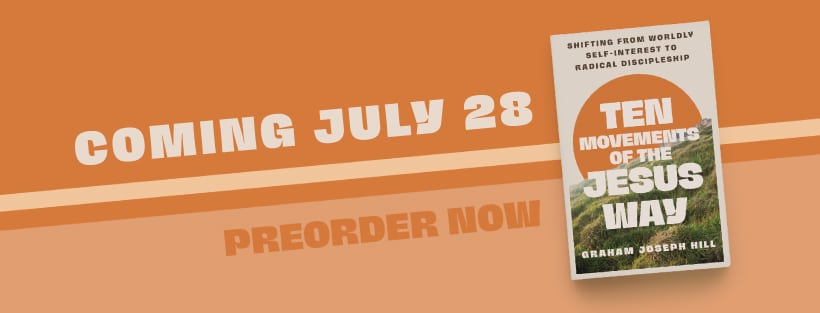
Graham Joseph Hill. Ten Movements of the Jesus Way: Shifting from Worldly Self-Interest to Radical Discipleship. InterVarsity Press, July 2026. Preorder here: https://www.ivpress.com/ten-movements-of-the-jesus-way
About This Series
This post is part of The Jesus Way, a weekly blog series exploring the ten movements that shape a life of following Jesus. Each movement traces a path the Gospels invite us to walk: from the patterns the world rewards toward the life Jesus actually lived and taught.
The series builds toward the release of my book, The Ten Movements of the Jesus Way, coming from InterVarsity Press on 28 July 2026. If you’d like to follow the full journey, you can subscribe to receive each new post as it’s published.
Preorder “The Ten Movements of the Jesus Way” here: https://a.co/d/004aPGwi