The Jesus Way – A Special Easter Reflection (Luke 22–24; John 13; 19–20)
The Story We Think We Know
Every year it comes around. The palms, the prayers, the somber Friday, the lilies on Sunday morning. We know the sequence. We’ve heard the readings. Many of us could recite the key lines from memory. And that familiarity is both a gift and a danger, because the story of Jesus’s death and resurrection is the kind of story that stops working when you think you’ve understood it.
The moment it becomes routine, the moment it settles into a comfortable liturgical groove, it loses the thing that made it shake the ancient world to its foundations. And what made it shake the ancient world was this: everything Jesus had been teaching, everything he’d been living, everything he’d been inviting people into, converged in a single week. The words became flesh in the most literal and devastating way possible. The teacher became the lesson.
This Easter, I want to walk through that week slowly. I want to linger in the rooms and on the roads where it happened. And I want to show how every thread of the Jesus Way, every movement we’ve been exploring in this series, finds its fullest expression in the days between a supper table and an empty tomb.
Thursday Evening: The Table
It begins with a meal. This is worth noticing, because meals are where Jesus did some of his most important work. He ate with tax collectors and sinners. He fed five thousand on a hillside. He told parables about banquets and wedding feasts. And now, on the last night of his life, he gathers his closest friends around a table.
John’s Gospel gives us the detail that the other Gospels don’t: before the meal begins, Jesus gets up from the table, wraps a towel around his waist, and starts washing his disciples’ feet.
In the first century, foot-washing was the job of the lowest household slave. Feet were filthy from the dusty roads. The task was demeaning, physical, intimate. And Jesus, whom these men had come to believe was the Messiah, the chosen one of God, kneels on the floor and does the work of a servant.
Peter objects. “You’ll never wash my feet,” he says. And you can hear in his protest the discomfort we all feel when someone we admire stoops lower than we think they should. Peter wants a Messiah on a throne. He’s getting a Messiah on his knees.
Jesus answers: “Unless I wash you, you have no share with me.”
This is the shape of everything that’s about to happen, compressed into a single act. The one with all the power empties himself. The one with the highest status takes the lowest place. The one who could command service chooses to serve. In this series, we’ve explored the movement from power to servanthood, and here it is, enacted on a stone floor with a basin of water and a towel. Jesus is showing his disciples what his death will mean: the God of the universe, kneeling at the feet of the world, washing away its filth.
And then the meal. Bread broken. Wine poured. “This is my body, given for you. This is my blood, poured out for many.” The language is sacrificial and deeply personal. Jesus is taking the Passover, the great story of liberation from slavery in Egypt, and rewriting it around himself. The lamb that was slain. The blood on the doorpost. The meal eaten in haste before the long journey to freedom. All of it now points to what will happen before sunrise.
Thursday Night: The Garden
After the meal, they walk to the Mount of Olives, to a garden called Gethsemane. The name means “oil press,” the place where olives are crushed to extract their oil. The symbolism is almost too heavy to bear.
Jesus asks his disciples to sit and wait. He takes Peter, James, and John further into the garden. And then Mark tells us something startling: “He began to be distressed and agitated.” The Greek words are ekthambeisthai and adēmonein. They describe a horror that overwhelms, a dread so deep it borders on disintegration. Jesus says to them: “My soul is overwhelmed with sorrow, to the point of death.”
This matters because it tells us that what happened on Good Friday was not a serene act of divine choreography. It was agony. Jesus knew what was coming, and every cell in his body recoiled from it. He fell on the ground and prayed: “Abba, Father, everything is possible for you. Take this cup from me. Yet not what I will, but what you will.”
In this series, we’ve explored the movement from frenetic activity to slow discipleship, the practice of abiding, the hard gift of surrender. And here in the garden, Jesus lives the fullest, costliest version of that surrender. He doesn’t want this. He asks for another way. And when no other way comes, he chooses trust. He places himself in the hands of a Father whose plan he can feel but cannot fully see.
The disciples, meanwhile, fall asleep. Three times Jesus returns to find them sleeping. “Couldn’t you keep watch for one hour?” he asks. There’s no anger in the question. There’s loneliness. The man who spent his ministry surrounded by crowds is facing his darkest hour alone.
And then the torches appear through the trees. Judas arrives with a kiss. The soldiers close in. And the longest night in history begins.
Friday Morning: The Trials
Between midnight and dawn, Jesus is passed from one authority to another: the high priest Caiaphas, the Sanhedrin, the Roman governor Pontius Pilate, the puppet king Herod, and back to Pilate. Each stop is a different kind of power asserting itself. Religious power. Political power. Imperial power. And at each stop, Jesus stands silent or speaks only a few words.
The trials are a masterclass in the dynamics of injustice. False witnesses are called. The charges shift depending on the audience. Caiaphas asks about blasphemy; before Pilate, the accusation becomes sedition. The religious leaders want Jesus dead for theological reasons. They need Rome to kill him for political ones. And so, the truth is reshaped, again and again, to fit the machinery of condemnation.
We’ve explored in this series the movement from indifference to justice. And here the opposite of that movement is on full display. Every institution that should protect the innocent is complicit in destroying him. The temple. The court. The empire. The crowd that shouted “Hosanna” on Sunday is shouting “Crucify him” by Friday. The systems that were meant to uphold righteousness are grinding it to dust.
And in the middle of it all stands Jesus, absorbing the full weight of human cruelty without returning it. When Peter cuts off a soldier’s ear in the garden, Jesus heals it. When the guards spit on him and strike him, he doesn’t retaliate. When Pilate asks if he’s a king, Jesus answers with a truth so quiet it barely registers above the shouting: “My kingdom is not from this world.”
This is the movement from retribution to forgiveness, lived in real time, under real blows. The one who taught “seventy times seven” is practicing it with every breath.
Friday Afternoon: The Cross
The crucifixion is so central to the Christian story that we’ve surrounded it with theology, art, hymns, and symbols until it’s easy to forget what it was: a method of execution designed by the Roman Empire to inflict maximum pain, maximum humiliation, and maximum terror. Victims were stripped, nailed or tied to a wooden cross, and left to die of slow asphyxiation, sometimes over the course of days. It was reserved for slaves, rebels, and the lowest classes. It was meant to say: this is what happens to those who defy our power.
And this is where the Jesus Way leads. The one who released his grip on wealth and status. The one who chose compassion over competition. The one who washed feet and overturned tables and ate with outcasts and prayed for enemies. The road he walked ends here, on a hill outside Jerusalem, between two criminals, with a mocking sign above his head.
Luke records seven things Jesus said from the cross, and several of them echo the movements we’ve been tracing all along.
“Father, forgive them, for they don’t know what they’re doing.” This is the prayer of someone who has so thoroughly absorbed the practice of forgiveness that it flows out of him even as the nails go in. He doesn’t wait for his executioners to repent. He doesn’t wait for them to understand what they’re doing. He forgives them in advance, freely, completely, with the same extravagance he taught in every parable about grace.
“Today you’ll be with me in paradise.” To the criminal hanging beside him, a man with no credentials, no religious resume, no time left to earn anything, Jesus offers the fullness of God’s welcome. The movement from exclusion to embrace, played out in the final hours of both their lives.
“My God, my God, why have you forsaken me?” This cry, drawn from Psalm 22, is the most harrowing line in scripture. It’s the sound of someone who has staked everything on the faithfulness of God and, in this moment, feels the absence of the one he trusted most. It’s the cry of every person who has ever suffered and wondered whether anyone was listening.
At three in the afternoon, Jesus dies. The Gospels tell us the curtain of the temple was torn in two, from top to bottom. The barrier between God and humanity, the thick fabric that said, “keep out, stay distant, you are not worthy to approach,” splits open. Access to God’s presence, once restricted to a single priest on a single day of the year, is thrown wide for everyone. The movement from legalism to grace, enacted in a single tear.
Saturday: The Silence
We rush past Saturday. The liturgical calendar gives us Good Friday and Easter Sunday, and the day between them gets lost. But I think Saturday is the day most of us live in.
Saturday is the day when the worst has happened and the redemption hasn’t arrived yet. The body is in the tomb. The stone is sealed. The disciples are scattered, hiding behind locked doors, trying to make sense of a story that seems to have ended in total defeat.
There’s no hope on Saturday. There’s no resurrection in sight. There’s only grief, confusion, and the crushing sense that everything they’d believed in has been destroyed.
We know Saturday. We’ve lived it. The diagnosis has come and the treatment hasn’t started. The relationship has ended and the healing hasn’t begun. The loss has hit and the meaning hasn’t emerged. We’re sitting in the rubble, and there’s no angel yet, no rolled-away stone, no voice saying, “Why do you look for the living among the dead?”
Saturday requires the hardest kind of faith: the faith that holds on when there’s no evidence that holding on is reasonable. The faith that sits in the dark and trusts that the dark is not the end of the story. Consider the lilies, Jesus said. Your heavenly Father knows what you need. On Saturday, those words feel almost impossible to believe. And believing them anyway is the deepest act of trust a human heart can manage.
Sunday Morning: The Garden (Again)
The story began in a garden, in Eden, where everything broke. It moved through another garden, in Gethsemane, where everything was surrendered. And now it arrives in a third garden, outside the tomb, where everything is remade.
John tells the story with exquisite care. It’s early, still dark. Mary Magdalene comes to the tomb. The stone is rolled away. She runs to tell Peter and the beloved disciple. They come, they see the linen wrappings lying empty, and they go home. But Mary stays.
She stays. This detail matters. In a story full of people who leave, who flee, who fall asleep, who deny, who betray, Mary stays at the tomb and weeps. And it’s to her, the one who stayed, that the risen Jesus first appears.
He says one word: “Mary.”
She turns. She recognizes him. “Rabboni,” she says. Teacher.
There’s a whole theology in that exchange. The God of the universe, freshly risen from the dead, having just conquered the grave and broken the power of death itself, stands in a garden at dawn and speaks a woman’s name. He doesn’t appear first to the authorities. He doesn’t appear to the crowds. He appears to a grieving woman who loved him and couldn’t leave. The movement from competition to compassion. The movement from exclusion to embrace. The movement from power to servanthood. They’re all here, in this quiet, intimate moment in a garden at first light.
The resurrection, as the Gospels tell it, is strikingly personal. Jesus appears to Mary. He walks with two disciples on the road to Emmaus, and they recognize him in the breaking of bread. He stands among the terrified disciples in the locked room and says, “Peace be with you.” He invites Thomas to touch his wounds. He cooks breakfast for Peter on the shore of the Sea of Galilee.
Each encounter is tailored to the person. Each one meets a specific grief, a specific doubt, a specific need. The risen Christ doesn’t issue a press release. He shows up in the places where people are broken and afraid, and he speaks their names.
What Easter Changes
The resurrection is the event that holds the entire Jesus Way together. Without it, the ten movements we’ve been exploring are beautiful teachings from a tragic figure. With it, they’re the blueprint for a new way of being human.
Because the resurrection says that the way Jesus lived, the self-emptying, the foot-washing, the forgiving, the embracing, the table-sharing, the truth-telling, the boundary-crossing, the enemy-loving way, is the way that wins. It’s the way that endures. It’s the way that death itself cannot extinguish.
Every empire that has ever existed has operated on the assumption that power flows from the top down, that the strong survive, that violence has the last word. The resurrection says otherwise. It says that the last are first. It says that the servant is the greatest. It says that love, poured out and given away, is the most durable force in the universe.
And it says that the worst thing is never the last thing. Friday is real. Saturday is real. The suffering, the silence, the sense of abandonment, all of it is real and none of it is denied. But Sunday comes. New life emerges from the place of death. And it emerges not as a reversal of Friday’s pain but as a transformation of it. The risen Jesus still has his wounds. Thomas can touch them. They’re part of who he is now. The resurrection doesn’t erase the suffering. It redeems it. It weaves it into a story larger than death.
Living in Easter
So, what does Easter mean for those of us trying to walk the Jesus Way in the ordinary landscapes of our lives?
It means that the movements we’ve been practicing are grounded in the deepest reality there is. When you choose generosity over accumulation, you’re aligned with the grain of the universe. When you kneel to serve, you’re doing what God does. When you forgive someone who hasn’t earned it, you’re participating in the same love that prayed for its executioners. When you welcome the excluded, you’re standing in the garden with Mary, hearing your name spoken by the risen Christ.
It also means that you can afford to fail. The resurrection is God’s declaration that failure, defeat, even death, can be transformed. Peter denied Jesus three times. On Easter morning, he ran to the tomb. A few weeks later, Jesus restored him on the beach with a three-fold question: “Do you love me?” The failure didn’t disqualify him. It became the soil from which a deeper faithfulness grew.
And it means you can afford to hope. In a world that gives us plenty of reasons for cynicism, plenty of evidence that the strong keep winning and the vulnerable keep suffering, Easter plants a flag. It says: this is the world where a crucified man walked out of a tomb. This is the world where death lost. Whatever darkness you’re facing, whatever Saturday you’re sitting in, the story has one more chapter. And the author has a track record of writing endings nobody expected.
A Practice for Easter Week
This week, I want to invite you into a practice that mirrors the rhythm of Easter itself.
On one day this week, practice Friday. Name something in your life that feels like death. A loss, a failure, a fear, a grief you’ve been carrying. Write it down. Don’t rush past it. Sit with the weight of it. Let it be real.
On another day, practice Saturday. Sit in the uncertainty. Resist the urge to fix, to resolve, to fast-forward to the happy ending. Simply be present to the not-knowing. Pray, if you can, the prayer of Gethsemane: “Not my will, but yours.”
And on another day, practice Sunday. Look for the signs of resurrection in your life and in the world. A relationship that’s healing. A hope that’s returning. An act of kindness that arrived when you least expected it. A moment when you heard your name spoken with love. Write it down. Let the evidence of new life accumulate.
And if you can, on Easter morning, do something to mark the day. Light a candle. Take a walk at dawn. Read John 20 slowly, out loud. Share a meal with someone. Let the story land in your body, in your senses, in the ordinary rhythms of the day.
Because Easter is meant to be lived, day by day, in every small act of courage, generosity, forgiveness, and love. Every time you choose the Jesus Way, you’re participating in the resurrection. You’re saying, with your life: death doesn’t have the last word.
A Question for Reflection
Here’s the question to carry with you this Easter:
Where in your life right now do you most need to hear the words “Peace be with you” spoken by someone who’s walked through death and come out the other side?
I’d love to hear what surfaces for you. Where are you in the Easter story this year? Are you at Friday, Saturday, or Sunday? What does the resurrection mean for the specific thing you’re carrying right now?
Share your reflections in the comments. And if this post spoke to you, pass it along to someone who might be sitting in Saturday and needs to hear that Sunday is coming.
He is risen. And because he is, everything is possible.
Grace and peace to you on the journey.
Image credit: Photo by Alicia Quan on Unsplash
New Book
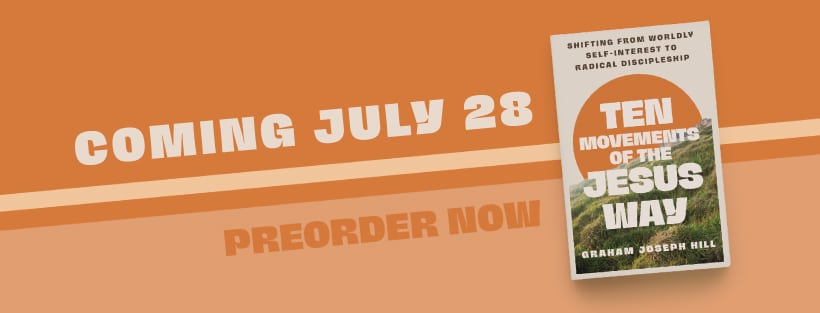
Graham Joseph Hill. Ten Movements of the Jesus Way: Shifting from Worldly Self-Interest to Radical Discipleship. InterVarsity Press, July 2026. Preorder here: https://www.ivpress.com/ten-movements-of-the-jesus-way
About This Series
This post is part of The Jesus Way, a weekly blog series exploring the ten movements that shape a life of following Jesus. Each movement traces a path the Gospels invite us to walk: from the patterns the world rewards toward the life Jesus actually lived and taught.
The series builds toward the release of my book, The Ten Movements of the Jesus Way, coming from InterVarsity Press on 28 July 2026. If you’d like to follow the full journey, you can subscribe to receive each new post as it’s published.
Preorder “The Ten Movements of the Jesus Way” here: https://a.co/d/004aPGwi